




Six tired chairs, one free Saturday, and the question we field on the phone every single week: can I just do this myself? The honest answer is that it depends on which chairs you own, and flipping one upside down will tell you most of what you need to know. This is not a how-to article. We already wrote a full step-by-step on how to completely recover a dining chair. This is the guide for deciding whether you should.
Flip a chair over before you decide anything
Underneath, you will find one of three situations, and they are three completely different jobs.
The drop-in seat. Four screws through the corner blocks hold a padded board into the frame. This is the friendly one. If your chairs have drop-in seats, DIY is a legitimate weekend project, and the step-by-step guide above walks you through every stage.
The upholstered-over frame. Fabric wraps the seat frame itself, with edges finished in welt cord, decorative nails or a folded hem, sometimes with an upholstered back panel too. Doable for a patient DIYer with good tools, but those finishing details are exactly where amateur jobs announce themselves.
The spring seat. Press down on the seat. If it gives and pushes back with a bounce, there are coil springs under there, held up by webbing and hand-tied twine. Keep reading before you order a single yard of fabric.
What DIY actually costs
The fabric store makes reupholstery look like a fabric purchase. It is really a tools-and-materials purchase:
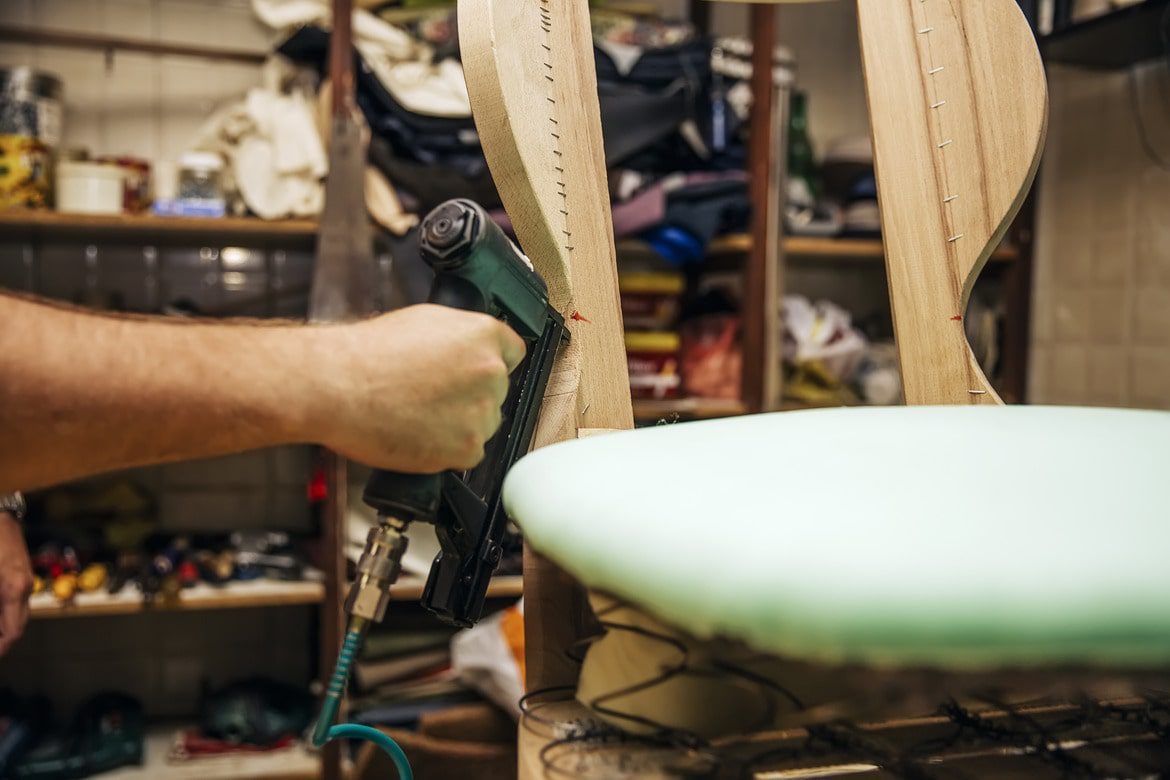
- A stapler that can sink staples flush into hardwood. Cheap hand staplers leave staples standing proud and your hand aching by chair two. An electric or pneumatic stapler is the real fix.
- A staple lifter and pliers for stripping. Pulling a few hundred old staples per chair is the part nobody’s video dwells on.
- New foam, batting and dust-cover fabric, because stretching new fabric over crumbling foam wastes the whole effort.
- Upholstery-weight fabric, and enough of it. More on that below.
By the time you outfit yourself properly and buy mid-grade fabric for six chairs, the total can climb to a few hundred dollars before the first staple goes in. Then there is time. Your first drop-in seat takes a couple of hours to strip and recover. By the sixth you will be faster, but a full set is a real weekend, not an afternoon. None of this means do not do it. It means compare the true numbers against a shop quote, not the fantasy numbers. Every piece is different, so call for an exact figure before you decide.
The yardage mistakes that blow the budget
Fabric buying is where most DIY budgets quietly die. The mistakes we see over and over:
- Buying exact yardage for a patterned fabric. A large repeat means each seat must be cut so the motif lands in the same spot on every chair. That can nearly double the yardage compared to a solid.
- Ignoring pile direction. Velvet and corduroy read lighter or darker depending on which way the pile runs. Cut two seats in opposite directions and they will look like different dye lots forever.
- Buying decorator or quilting cotton. If it is not upholstery weight, it will wear through at the seat edges within a couple of years.
- Buying no spare. One miscut or one torn corner, and you are hunting a discontinued fabric. Add at least an extra half yard.
As a rule of thumb, a drop-in seat takes about three quarters of a yard of plain 54-inch fabric, and generously more for pattern repeats or over-the-frame chairs.
When a spring seat will eat you alive
Here is the trap. The video makes a spring seat look like a bigger version of a drop-in seat. It is not. Under that fabric sits jute webbing stretched drum-tight with a tool you do not own, coil springs tied by hand in several directions so they compress evenly, then burlap, edge roll, stuffing and shaped padding. Every layer depends on the one below it.
On old chairs the webbing is usually dry-rotted, so honest work starts with stripping to the bare frame. Hand-tying springs is a skill built across dozens of seats, not learned in one. Tie them unevenly and the seat creaks, wanders and slopes to one side within a month. We regularly receive chairs with a plywood board screwed in where the springs used to be, a little monument to the moment a weekend project surrendered. If the chairs are antiques with horsehair stuffing on top of those springs, you are firmly in professional territory.
What a pro shop does differently, and when to hand it over
Part of it is equipment. Our walking-foot Consew machines sew welt cord through layered corners that a home sewing machine simply cannot feed. Part is materials, commercial-grade foam in the right density and fabric lines rated for real wear. And part is plain repetition. Keeping tension and pattern placement identical across eight chairs is the difference between a set that looks redone and a set that looks new.
There is also what happens before any fabric appears. We catch loose glue blocks and wobbly joints and fix them while the chair is stripped, because covering a loose frame with fresh fabric just gift-wraps the problem.
So here is our honest sorting rule. Drop-in seats on sound frames: try it yourself, enjoy it, use our guide. Springs, welt details, antiques, or simply eight chairs and a busy life: bring them to our furniture upholstery shop or call 717-383-6917, and we will quote it straight.
FAQ
Is reupholstering cheaper than buying new chairs?
Compared with quality new chairs, usually yes, especially for drop-in seats. Compared with big-box chairs, sometimes not, but that comparison is unfair. A solid maple chair from the 1960s, recovered today, will outlive anything that arrives in a flat box. Fabric choice moves the price a lot, so call for a real estimate.
How do I know if my chairs are worth the work?
Pick one up. Solid hardwood chairs feel heavy for their size, and the joints are doweled or mortised rather than stapled. If the frame is sound hardwood, it is almost always worth recovering. If it flexes when you twist it gently, put the money toward better bones.
How long does a shop take with a set of six?
Fabric delivery and the shop schedule matter more than the labor itself, so ask when you book and we will give you an honest date. If you need the set back for a holiday dinner, tell us early. November in a Central PA upholstery shop is its own season.
Not sure which kind of seat you own? Snap one photo of the top and one of the underside and send both through our free online estimate page, or call 717-383-6917. Two pictures are usually all we need to tell you whether you are looking at a pleasant Saturday or a rescue mission.

