





The Banquette That
Becomes the Room.
A full U-shaped built-in with cream leather channel-back, fitted to a Chester County luxury kitchen. Here is how it came together.
Built-in banquette seating sounds simple until you are standing in a half-finished kitchen with a measuring tape trying to figure out why the corner is not a right angle. Spoiler: it almost never is.
This project, for a Chester County homeowner finishing a high-end kitchen renovation, involved a full U-shaped built-in wrapping two walls. Cream leather channel-back upholstery. A raw hardwood frame built on-site. Black marble waterfall islands flanking both ends. The kind of job where every inch counts and there is no going back once the marble goes in. Alex loves those jobs. Mostly.
We do a lot of residential upholstery across Chester County and the Main Line. Most of it is chairs and sofas. This one was different. A full custom fabrication project that required treating the banquette as architectural furniture rather than just upholstery. Here is the full story.
Two walls plus corner
Continuous horizontal
Site to finished install
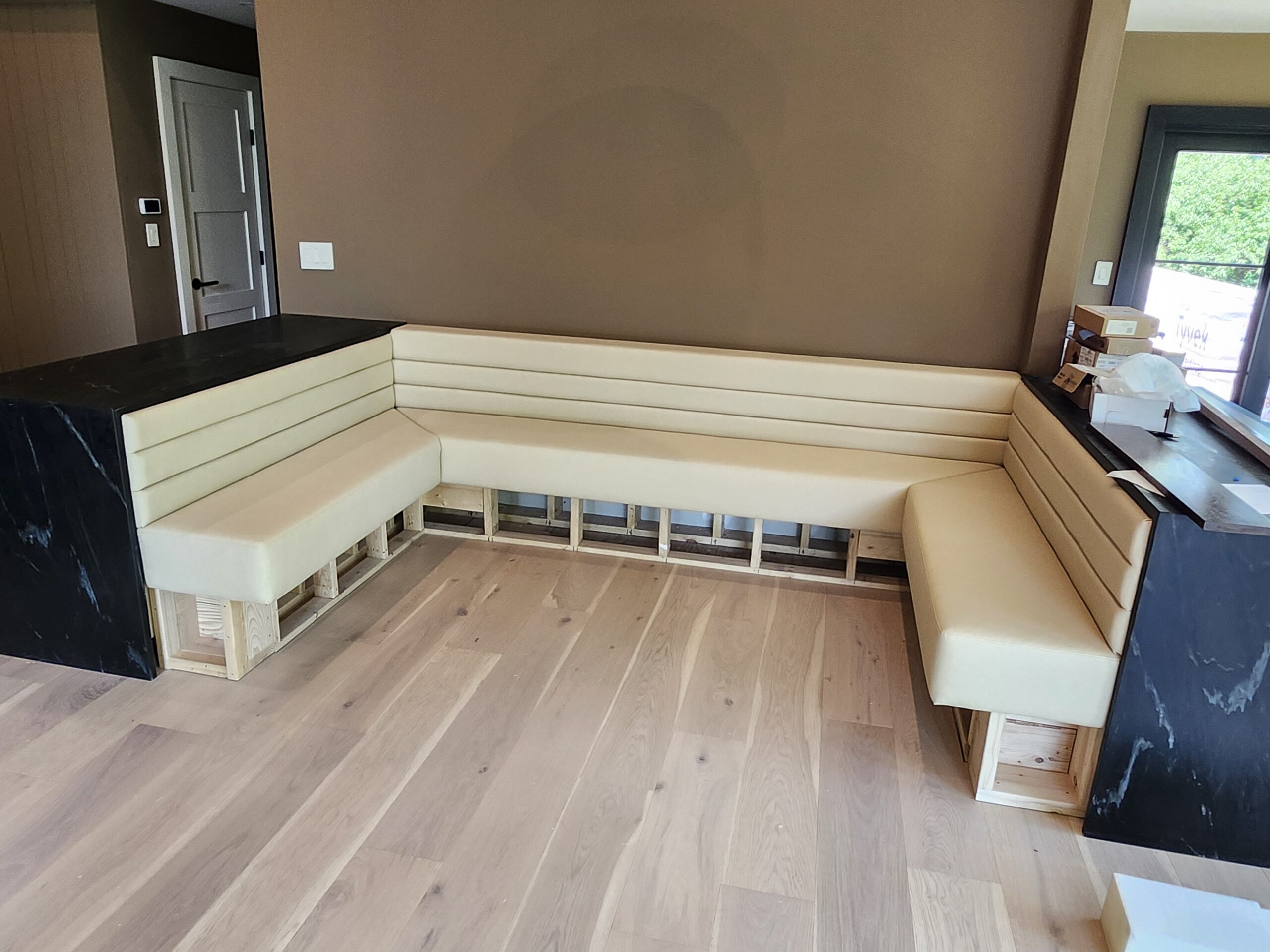
The finished banquette before the base trim was completed. Corner seam is invisible from any seated position.
Why This Project Started With the Room, Not the Fabric
When a Chester County homeowner calls about a built-in banquette, the conversation always starts the same way. They show Alex a Pinterest photo of a beautiful built-in and ask how much it costs. Fair question. But the answer depends entirely on the room, not the photo.
This kitchen had two complicating factors that determined everything. First, the black marble waterfall islands on both ends of the planned banquette area meant the seat height and depth had to align precisely with the countertop overhangs. There was no adjusting the marble after the fact. Second, the two walls meeting in the corner were not perpendicular. Not by a lot, but enough that a standard 90-degree frame would have left a gap in the back panel that no amount of cushioning could hide.
Built-in banquette seating is architectural work. The upholstery is the last thing that happens. Getting there requires the same level of precision as cabinetry, because in a finished luxury kitchen, it is cabinetry.
Alex's approach on jobs like this is to build the frame on-site, in place, rather than fabricating in the shop and delivering. For a standard restaurant booth against a flat wall, the shop build is faster. For a residential built-in fitting between two fixed marble islands with a non-square corner, the on-site build is the only way to get a result that looks like it was always supposed to be there.

The kitchen before framing began. The marble islands were already set. The banquette had to fit exactly between them.
The Frame: Built on Site, Built to the Room
Material
The frame is kiln-dried pine, visible in the process photographs before the base trim panels were installed. Pine is the right choice for a residential built-in of this configuration. Lighter than hardwood, easy to cut and adjust on-site, and fully adequate structurally for residential seating loads. The frame does not need to survive a restaurant doing 200 covers a day. It needs to fit perfectly and hold its shape for the next twenty years. Different standards, different materials.
Corner Construction
The corner section of a U-shaped banquette is where most of the critical work happens. Alex built the corner unit first, shimmed and leveled it against both walls, verified the seat height alignment with both marble island surfaces, and then built outward from there. Each run of seating was constructed as a continuous section rather than separate units butted together, which is what eliminates visible seams in the back panel at the corners.
Seat Height and Depth
Standard banquette seat height is 18 inches. Standard seat depth is 18 to 20 inches. This installation required a seat height of 17.5 inches to align with the marble overhang and maintain a comfortable table-height relationship. Half an inch sounds insignificant. At the scale of a full U-shaped banquette, it is the difference between a built-in that looks purpose-built and one that looks like furniture placed in a room. Alex notices these things so you do not have to.


The completed pine frame, built in place between the two marble islands. Corner first, then both runs outward. Shimmed and leveled before a single piece of foam went on.
The Upholstery: Cream Leather, Horizontal Channel-Back
Material Selection
The homeowner's brief was clear: cream, leather-look, durable enough for a kitchen environment, and consistent with the warm stone and natural oak aesthetic of the room. Alex specified a Grade A cream bonded leather, the same specification used for restaurant and hospitality seating. It gives the look and feel of genuine leather with significantly better resistance to the moisture, cleaning products, and temperature variation that a kitchen built-in will face.
The specific cream tone was selected to coordinate with the warm undertones of the wide-plank oak floor rather than the cooler grey of the wall color. In a room with black marble, warm oak, and brown-grey walls, a cool white would have looked clinical. The warm cream reads as deliberate and refined. More material options are in the fabric and leather collection.
Horizontal Channel-Back
The three horizontal channels on the back panels are the design detail that makes this banquette look more like furniture and less like seating. Each channel is an independently padded run of foam, separated by a tight machine-sewn seam. This gives the back panel visual structure and prevents the flat, slightly deflated look that single-pad backs develop within a few years. The channels also add a subtle acoustic softness to the kitchen. Upholstered surfaces absorb sound, and a room with marble, hardwood, and glass needs every soft surface it can get.
Corner Continuity
Getting the channel-back to read as continuous around the corner requires pre-planning the channel heights at the frame stage. The horizontal channel seams on the long run and the corner section have to align at the same elevation. Alex marks these heights on the frame during construction, before any foam or material is applied. That is what produces the seamless wraparound appearance in the finished installation.
"Getting the channel lines to wrap the corner seamlessly means planning it at the framing stage, not fixing it at the upholstery stage. By the time the foam is going on, it is already decided."
Alex, Alex Upholstery Shop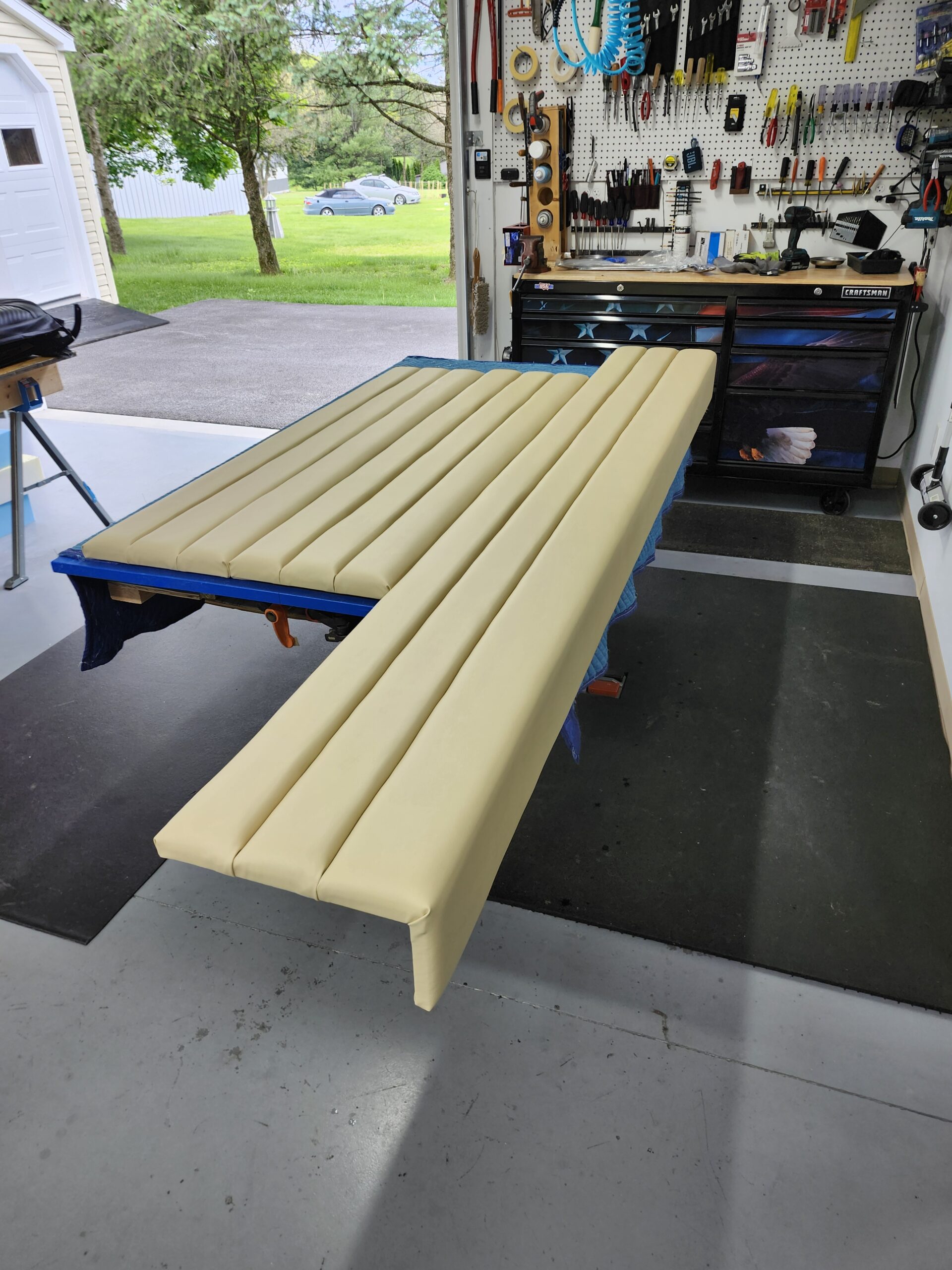

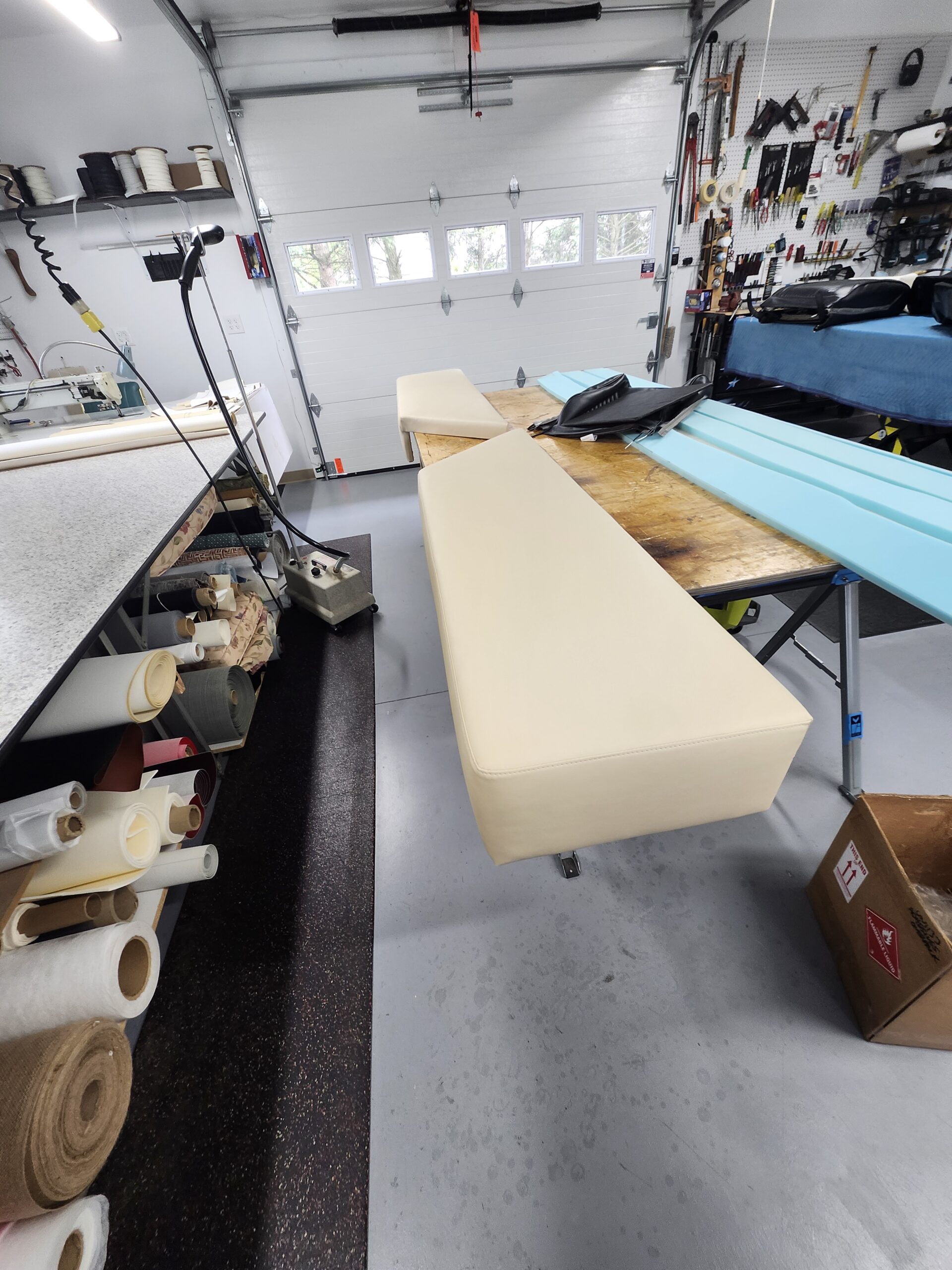
Foam cut and adhered. Channel-back panels pre-sewn and ready to apply. At this stage the channel heights are committed. There is no adjusting them after the vinyl goes on.

Seat cushions in place, back panels fitted. Base trim panels still to come from the homeowner's carpenter.
Corner section. Three channels align continuously across both panels. The seam at the corner is at the back edge, not visible from the seated position.
What a Full Built-In Banquette Project Covers
Residential Upholstery Across Chester County and the Main Line
Chester County and the Main Line corridor, Wayne, Malvern, Paoli, Berwyn, West Chester, Kennett Square, represent the most design-conscious residential market in Pennsylvania. Homeowners in this area are finishing rooms at a level where the upholstery has to hold its own against custom cabinetry, natural stone, and architectural lighting. That is a different standard from a sofa re-cover, and it is work Alex has been doing for over 32 years across the region.
Beyond built-in banquettes, we handle the full range of residential upholstery for Chester County and Main Line clients:
See examples in the before and after gallery and the antique restoration portfolio.
Frequently Asked Questions
Building something worth doing right?
Send Alex photos of your space and what you have in mind. You will hear back the same day with a straight answer on what it takes.
Serving Chester County, Main Line, Lancaster, York, Harrisburg and all of Eastern PA


