




The Chair That Went
Back to the Beginning.
An Ethan Allen club chair stripped to the frame, rebuilt from the springs up, and recovered in a fabric the owner chose herself. Here is the full story.
Ethan Allen has been building furniture in North America since 1932. Their club chairs from the mid-century and later periods have frames that are genuinely worth restoring. Solid hardwood, proper joinery, coil spring suspension that was built to last decades. When a Delaware County homeowner brought this one in, the frame was sound, the springs were intact, and the original fabric had simply reached the end of a long and well-used life. The brief was to bring it back completely, not patch it. Alex stripped it to the frame, assessed every joint and spring, and built it back up from scratch.
The matching ottoman came in with the chair. Same fabric, same level of work. The finished pair is back in the client's home, looking like the chair was re-issued rather than restored. That is the goal. See more residential and antique furniture restoration work in the full portfolio.
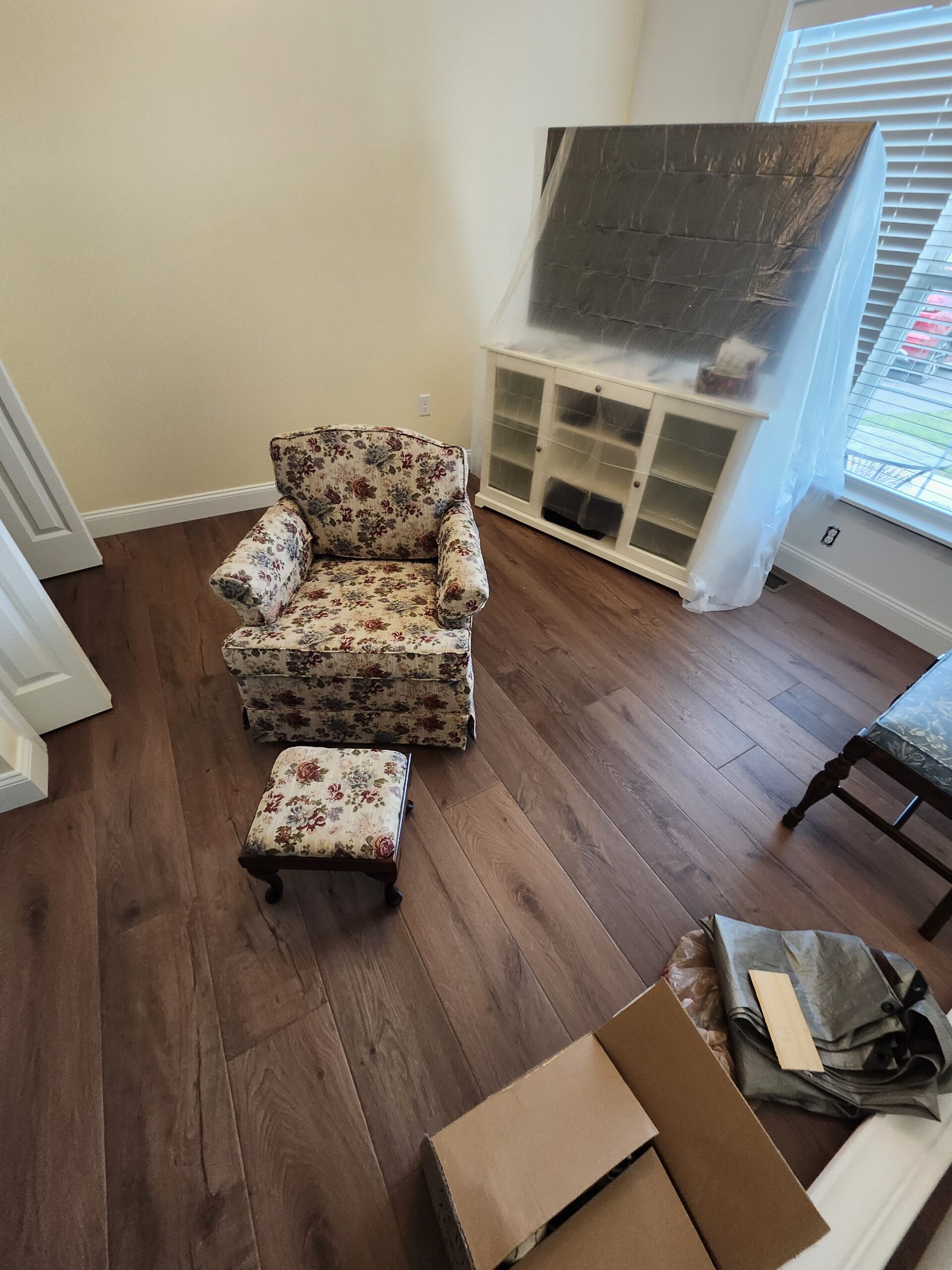
Left: the frame after stripping. Every spring, tack strip, and webbing removed for assessment. Right: completed chair in the client's Delaware County home.
Chair and ottoman
reused in final build
restoration experience
Why Ethan Allen Club Chairs Are Worth Restoring
There is a category of furniture that gets described as "vintage" when it ages and "antique" when it reaches a certain birthday, but the more useful category is simply "worth keeping." Ethan Allen club chairs from the postwar period forward are worth keeping because the frames are built to a standard that most current production furniture does not meet.
The frame on this chair is kiln-dried hardwood throughout, with mortise-and-tenon joints at the primary stress points and corner blocks reinforcing the seat frame. The coil spring suspension is tied to the frame on a sinuous wire support system that distributes seat load evenly and resists the permanent compression that foam-only seats develop over time. None of that changes with age. What changes is the fabric, the padding, and the surface materials. Those are exactly the things that can be replaced.
A well-built furniture frame does not have a lifespan. It has maintenance intervals. The Ethan Allen frame on this chair will outlast the new upholstery by decades, just as it outlasted the original. That is the point of the restoration.
For Delaware County homeowners, the calculus on restoration versus replacement is particularly clear. A comparable new club chair from Ethan Allen or a similar brand runs $2,000 to $4,500. A full restoration of an existing chair with a frame in this condition runs a fraction of that, and the client ends up with a chair that is better than new: their frame, their scale, their fabric choice, rebuilt to current upholstery standards.
The Frame: What Stripping Down Reveals

The frame after complete stripping. Coil spring seat system intact and correctly tensioned. The burlap dust cover at the back reveals original webbing still serviceable underneath.
Stripping a chair completely is not always necessary for a re-cover. If the padding is in good condition and the springs have not shifted, working over the existing base is reasonable. On this chair, Alex stripped to the frame for three reasons. The original padding had compressed to the point where rebuilding over it would produce a chair that sat wrong. The burlap on the back panel had deteriorated and was failing at the tack points. And a full strip is the only way to verify that the frame joints are tight before new materials go on top of them. Finding a loose joint after the chair is upholstered means doing the work twice.
Spring Assessment
The coil spring seat was the best news in the assessment. The sinuous wire support system was intact with no broken wires or detached end clips. The coil springs themselves retained their height and tension. Alex re-tied the spring deck and applied new burlap over the spring tops before any foam went on, which is the correct sequence. Burlap over the springs provides the surface that the foam sits on and prevents the foam from working down between the coils over time.
Frame Joint Check
All frame joints were checked for movement and re-glued where any give was present. The front scroll arm joints on Ethan Allen club chairs of this period occasionally develop slight looseness at the arm-to-rail connection from years of armrest loading. One joint on this chair needed re-gluing and clamping before the build-up could begin. A fifteen-minute step that prevents a developing problem from becoming a structural failure years later.


Mid-process: new foam and cotton batting applied to the rebuilt frame. The scroll arm shape is preserved by building the padding in layers rather than applying a single block.
The Fabric: Choosing the Right Material for a Classic Chair
The floral fabric the owner selected is a medium-weight woven upholstery fabric with a cream ground and a traditional botanical print in reds, pinks, and blues. This is a pattern with a long history in American residential upholstery, and it is exactly right for this chair. The scale of the print is proportioned to the size of the chair. The colors work with the dark wood of the ottoman legs and the hardwood floor of the room. And the cream ground brightens a corner that might otherwise read as heavy with a dark solid fabric.
The fabric is available through our full fabric collection. For clients who bring their own material, Alex also works with COM (customer's own material) on residential restoration projects.
Pattern Matching
A floral print at this scale requires careful pattern placement across the chair. The center of the seat cushion, the center of the seat back, and the center of the outside back all need to align with a repeating element in the print rather than landing in the middle of a gap. Alex lays the fabric over each surface before cutting to establish the repeat position, marks the cut lines against the pattern, and cuts each panel with the repeat mapped. The result is a chair where the fabric looks continuous rather than assembled from mismatched fragments.
The Ottoman
The ottoman was covered in the same fabric with the same pattern-matching approach. The cabriole legs were left as found, their dark finish in good condition and appropriately contrasting against the light floral fabric. The ottoman pad was rebuilt with new foam to match the profile of the original.
"Pattern matching is the part most clients do not notice when it is done right. They notice it immediately when it is done wrong. The goal is a chair where the fabric just looks like it belongs."
Alex, Alex Upholstery Shop
Completed chair and ottoman in the shop before delivery. Pattern centered on seat and back. Ottoman profile matches the chair seat height correctly.
Full Restoration Specification

Back in the client's Delaware County home. The chair has been in this family for decades. It will be for decades more.
Residential Upholstery for Delaware County and the Main Line
Delaware County, along with the Main Line corridor, Chester County, and Montgomery County, represents one of the most concentrated markets for quality residential furniture restoration in Pennsylvania. Homes in Media, Newtown Square, Wayne, Haverford, Swarthmore, and across the broader Delaware County area have generations of well-built furniture that is worth maintaining rather than replacing.
Alex serves homeowners throughout Delaware County and the adjacent suburban Philadelphia market for the full range of residential upholstery work:
Browse before and after examples in the full gallery and the residential furniture upholstery page.
Frequently Asked Questions
Have a chair worth
bringing back properly?
Send Alex photos of the piece and a note on what you are looking for. You will hear back the same day with a straight answer on scope, timeline, and what it takes.
Serving Delaware County, Main Line, Chester County, and all of Eastern Pennsylvania.


