


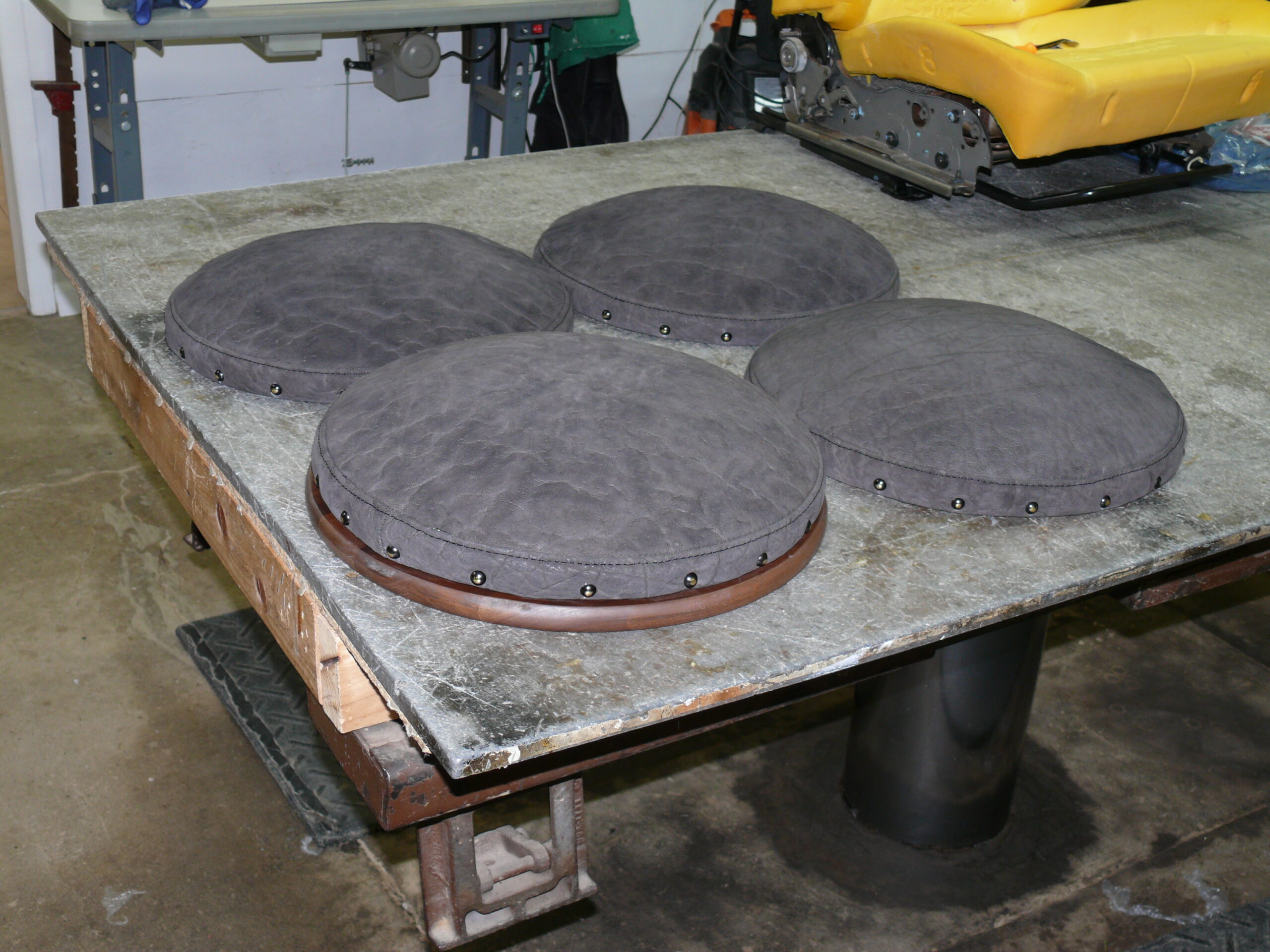
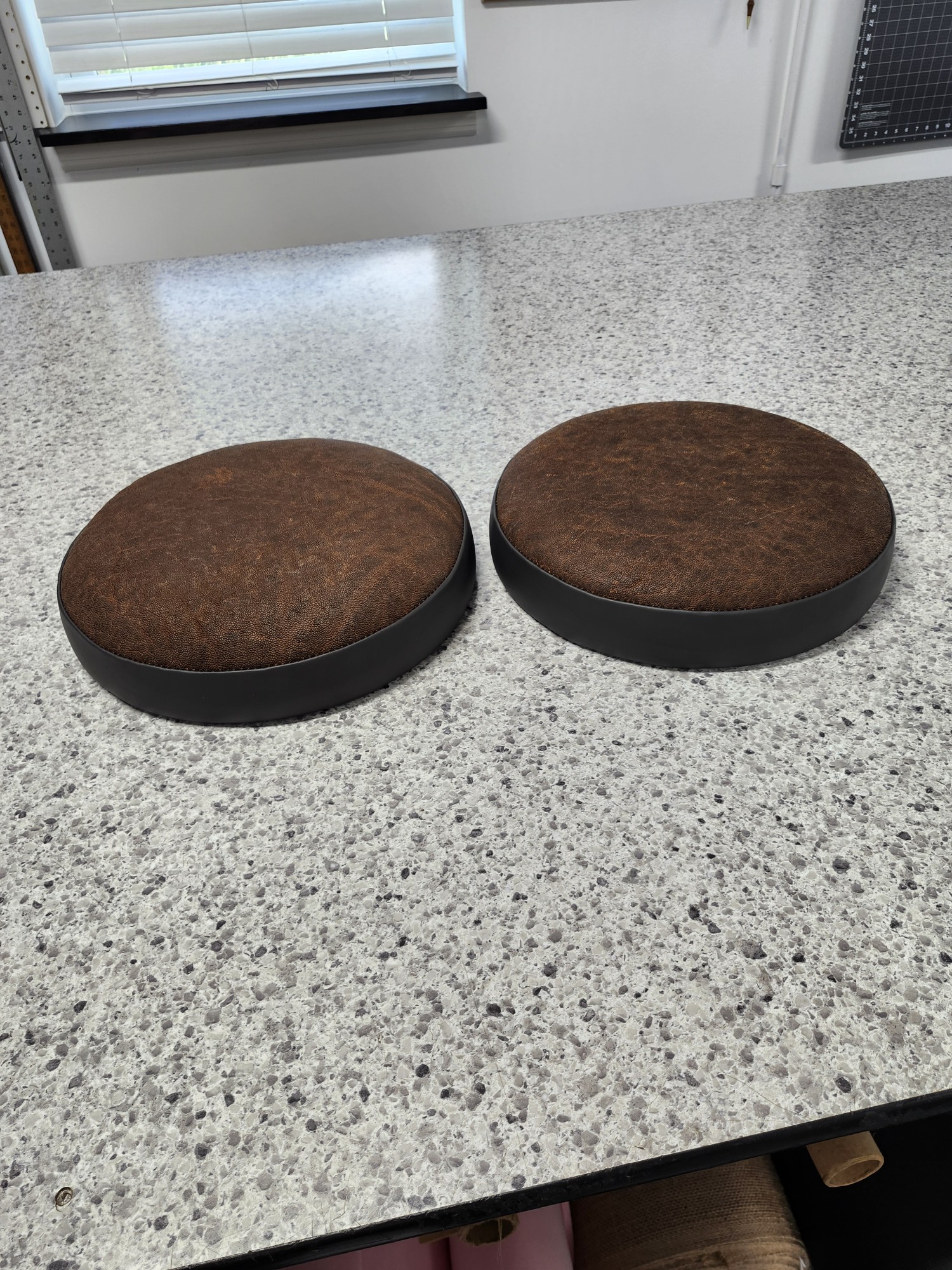
Most upholstery shops will politely decline the moment you open the box. Elephant hide is two to three times thicker than cowhide, the grain runs in every direction at once, and a home machine will simply refuse to participate. So when collectors search for exotic leather upholstery Pittsburgh PA and western Pennsylvania can offer, the trail eventually leads to our bench in Myerstown. This batch was a good one: six round stool seats in genuine elephant leather, four in slate gray with brass nailhead trim and two in rich brown, plus one project you do not see every decade, a real elephant foot stool crowned with a zebra hide cushion.
All hides on these projects were client supplied, legally imported, and properly documented. That is the only way we touch exotic material, and serious collectors would not have it any other way. Once the paperwork is right, the rest is what we have done for 32 years: precise custom cushion work, honest furniture upholstery, and seams that hold. You can browse our regular fabric and leather options too, but this post is about the wild stuff.
Why Elephant Leather Humbles Ordinary Equipment
Elephant hide is the heavyweight division of the leather world. It is dense, it is thick, and its signature cracked grain pattern means no two square inches look alike. That grain is exactly why collectors love it, and exactly why it punishes anyone who tries to sew it with standard gear. A domestic machine skips stitches, breaks needles, and gives up. Our walking foot industrial machines with heavy bonded thread walk through it the way the original owner walked through the bush: slowly, deliberately, and without arguing.
Pattern layout matters more with elephant than with any cow leather. Because the grain varies wildly across the hide, we lay out every seat panel to center the most dramatic texture on the crown of the cushion where eyes and hands land first. On this set of four, each seat got its own character while the group still reads as a matched family. That is not luck. That is an hour of moving templates around before the knife touches anything.

The Elephant Foot Stool: Trophy Room Furniture With a Century of Tradition
Elephant foot stools and ottomans go back to the classic safari era, and surviving examples are family heirlooms that get passed down with the stories attached. This one came to us with a tired, flattened top that did not do the piece justice. We built a new upholstered cushion crowned in zebra hide, banded it in chocolate leather, and fitted it to the original form so it seats cleanly without stressing the vintage hide below.
Work like this sits somewhere between upholstery and conservation. The rule is simple: everything we add must be reversible, and nothing we do may damage the original. If your family has a piece like this in the den, gathering dust because nobody knows who to trust with it, that is precisely the phone call we like getting.
The Seat Construction
Each round seat starts with a plywood or hardwood base, high resiliency foam shaped into a soft crown, and a polyester wrap so the leather pulls smooth without hard shoulders. The elephant hide is stretched, stapled in a star pattern to keep tension even around the circle, then finished with either decorative nailhead trim or a clean boxing strip, depending on the stool it returns to.
The Stitching Spec
Bonded nylon thread in 138 weight, heavy leather point needles, and a walking foot machine set slow. Top stitching on a crowned round seat has nowhere to hide, so the stitch line must track the circumference perfectly. On the brown pair we ran a black boxing band for contrast, so the seats read tailored from the side and wild from the top.
Before you ship us a hide: exotic leathers must come with proper import documentation. Keep every certificate that came with your hide or trophy. It protects the value of the piece, it protects you at resale, and it is the first thing we ask about, before dimensions, before color, before anything.
"Cowhide forgives you. Elephant hide takes notes. You get one chance to cut it right, so you measure like the hide is irreplaceable, because it is."Alex, Alex Upholstery Shop
| Spec | Detail |
|---|---|
| PIECES | Four gray elephant hide stool seats, two brown elephant leather stool seats, one elephant foot stool with zebra hide top |
| MATERIAL | Client supplied, legally imported and documented elephant hide and zebra hide |
| CONSTRUCTION | Hardwood and plywood bases, HR foam crowns, poly wrap, star pattern tension stapling |
| THREAD | Bonded nylon 138, leather point needles, walking foot industrial machine |
| TRIM | Brass nailhead on the gray set, black boxing band on the brown pair, leather banding on the foot stool |
| USE CASE | Bar stools, counter stools, and trophy room furniture |
Options and Pricing: Exotic Leather Upholstery for Pittsburgh PA Collectors
Western Pennsylvania has one of the deepest hunting and collecting cultures in the country, and Pittsburgh area trophy rooms hold hides and mounts that deserve better than a generic recovering job. Clients from Pittsburgh, Cranberry Township, Washington, Greensburg, and Wexford work with us the easy way: photos and measurements through the free online estimate first, then the seats or hides travel by box while the furniture stays home. Round stool seats are the perfect mail-in project, and finished seats ship back ready to bolt on.
Our exotic and specialty leather services include:
- Bar stool and counter stool seats in elephant, ostrich, bison, and other exotic hides
- Zebra, cowhide, and hair-on-hide cushions, benches, and ottoman tops
- Trophy furniture restoration, including elephant foot stools and safari era pieces
- Working with client supplied hides from your own collection or taxidermist
- Standard and premium leather upholstery for chairs, sofas, and vehicle interiors
- Custom built furniture designed around a specific hide or trophy
Every exotic project starts with a conversation about the material, the documentation, and what the piece needs to survive real use. Send photos through the free online estimate form and you will hear back from Alex, the person who actually runs the machine.
Frequently Asked Questions
When you supply the hide, round stool seats in exotic leather typically run 150 to 400 dollars per seat depending on size, trim, and construction. Trophy furniture restoration like an elephant foot stool top generally lands between 400 and 900 dollars. Larger pieces such as chairs or ottomans in exotic hide are quoted individually. Send photos through our free online estimate for an exact number.
Yes, and most Pittsburgh area clients do exactly that. Unbolt the seats, box them with your hide, and ship to our Myerstown PA shop. Finished seats ship back ready to install. For pieces that cannot travel, accurate measurements and photos are usually enough to build replacements.
We only work with client supplied exotic hides that were legally imported with proper documentation. Keep the paperwork that came with your hide or trophy. If documentation is missing or questionable, we will decline the project, which protects both of us and the value of your piece.
Extremely. Elephant hide is one of the toughest upholstery leathers in existence, significantly thicker and more abrasion resistant than cowhide. Built on a proper foam and wood base with bonded nylon thread, these seats will outlast the stools under them. The grain also hides minor scuffs better than smooth leather.
A set of stool seats is typically completed within one to two weeks of the hide and seats arriving. Trophy restoration pieces take two to three weeks because fitting and reversible mounting are done slowly on purpose. Mention any deadline in the estimate form and we will tell you honestly whether it works.
More Work from the Shop
Other projects where the material had opinions.
Got a Hide Worth a Real Craftsman?
Send photos of your hide, trophy, or stools and get a straight answer from Alex, the same hands that sewed everything on this page. Serving Pittsburgh, all of Pennsylvania, and collectors across the Northeast.