



A 72-Inch Sofa.
A Century of Good Bones.
An antique Mission-style settee with a frame that has outlasted everything put on it so far. New box cushions in sage green paisley. The frame was never the problem.
Frederick, Maryland has more Victorian and early-twentieth-century homes per block than most cities its size, and more antique furniture in active daily use to go with them. When a Frederick-area homeowner brought this 72-inch Mission-style settee to Alex, the brief was not complicated: the frame is original, the frame is beautiful, the cushions have given up. Make new ones that are actually comfortable and look like they belong on this piece.
The settee in the second photograph is placed in a room that has clearly been furnished with intention over a long time. The matching green armchair to the left, the Mission rocker to the right, the hardwood floors, the antique cupboard. This is not a room assembled from a catalog. It is a room that has been lived in and cared for, and the new cushions are part of continuing that care. Alex makes replacement cushions for antique and vintage furniture for clients across Maryland, Pennsylvania, New Jersey, and the broader Mid-Atlantic region. Here is the full picture of this project.
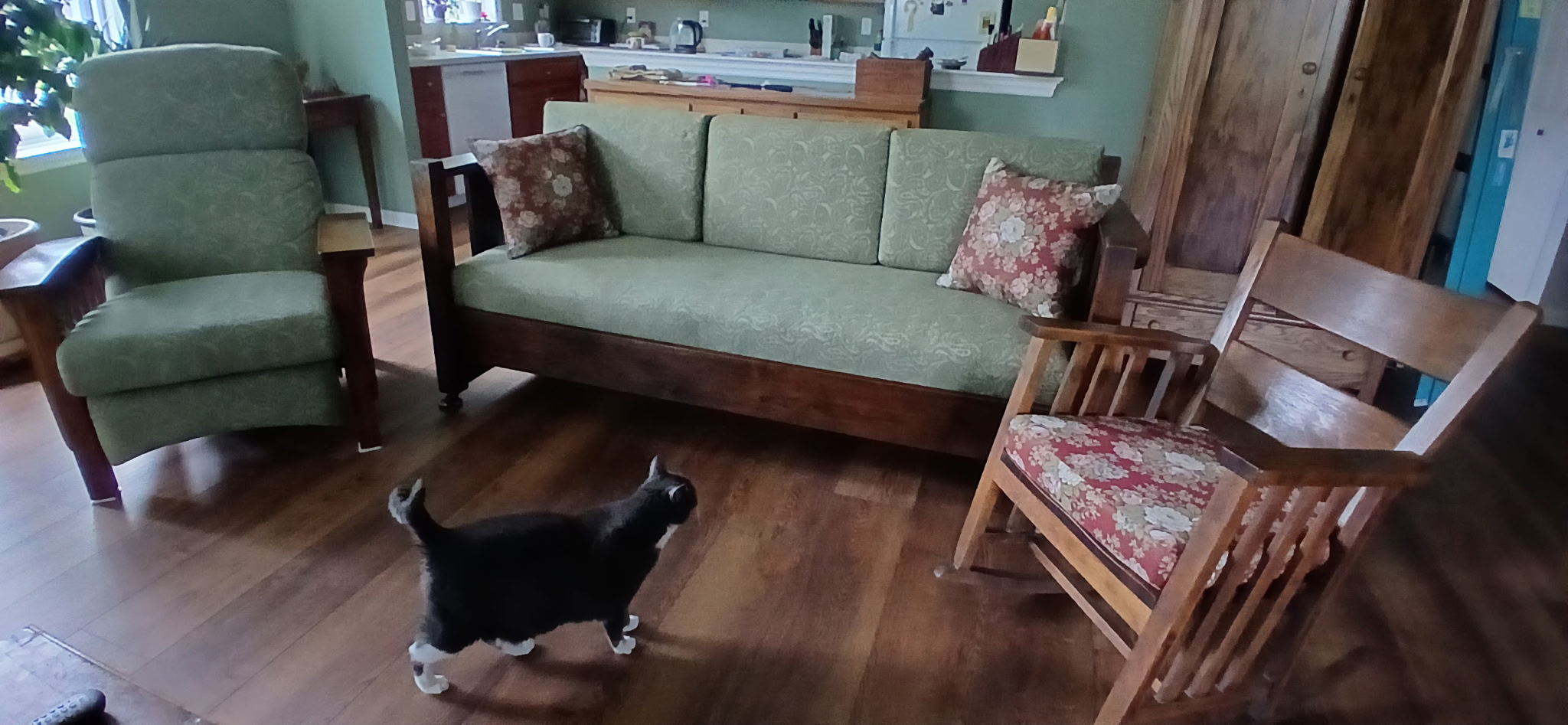
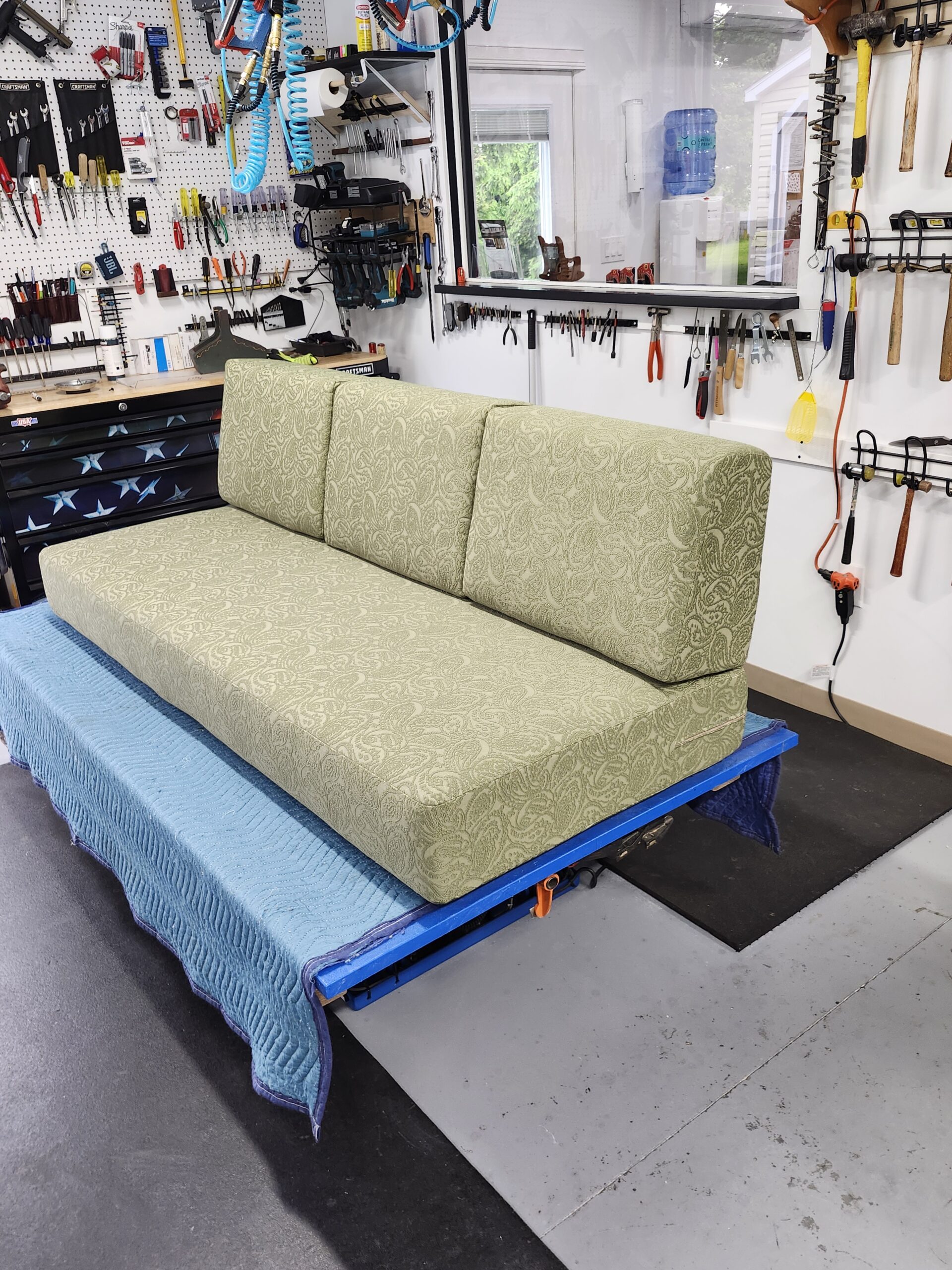
Left: completed cushions in the shop before delivery. Right: the settee in the client's Frederick MD home — sage green reads beautifully against the warm mahogany frame and coordinates with the matching armchair.
Three back cushions
Bench seat + 3 backs
has been in service
About the Mission Style and Why the Frame Outlasts Everything Else
The American Arts and Crafts movement, which produced the Mission style in furniture, ran roughly from the 1890s through the 1920s. Its core principle was a reaction against Victorian ornament: honest materials, visible joinery, straight lines, and construction quality that was meant to show rather than hide. Gustav Stickley, the most prominent manufacturer of the period, built settees and sofas with solid quarter-sawn white oak or mahogany frames using mortise-and-tenon joints pegged with square oak keys. Those joints are still holding a century later in pieces like this one.
The cushion system on a Mission settee was always meant to be separate and replaceable. Unlike a traditional upholstered sofa where fabric is built directly onto the frame, a Mission settee has a wooden frame with a platform for loose cushions to sit on. This is functionally honest construction: the cushions wear out, the frame does not, and replacing the cushions requires no structural work on the piece at all. It is also why Mission furniture from this period is worth keeping indefinitely. The maintenance interval is cushions, not frames.
A Mission settee frame in this condition will outlast any cushion set placed on it by decades. The work here is making cushions that are comfortable, correct in dimension, and beautiful enough to honor the frame they sit on. Nothing about the frame needs attention. Everything about the cushions did.
The Metropolitan Museum's overview of the American Arts and Crafts movement is a good primer on the design philosophy behind pieces like this settee if the history of the style is of interest. For the purposes of this project, the relevant point is that the frame is original, sound, and worth equipping with cushions that last.
Completed in the shop before delivery. Three back cushions and a full-width bench seat cushion. The paisley print is centered on each back panel and the seat cushion seam lines align with the back cushion divisions.
The Fabric: Sage Green Paisley on a Mission Frame
The sage green paisley is a medium-weight woven upholstery fabric with a tone-on-tone pattern in two values of the same green. It is not a loud choice, which is exactly right for a Mission piece. The Arts and Crafts aesthetic favors natural colors, organic forms, and materials that recede into the overall composition of the room rather than competing for attention. A bold primary-color fabric on this settee would fight the frame. The sage green works with the dark mahogany tone and disappears into the room in the right way — present and beautiful but not dominant.
Pattern Matching Across the Three Back Cushions
The three back cushions are individual pieces, but they need to read as a continuous back when placed side by side on the settee. Alex patterns the back cushions so the paisley repeat flows across all three panels without interruption at the seams. When the cushions are placed on the settee, the back reads as one surface. When individual cushions are moved or replaced independently, each still looks correct on its own. This requires calculating the repeat position for all three cushions simultaneously before any cutting begins, which takes more time than cutting three independent pieces but produces a settee that looks designed rather than assembled.
Bench Seat Alignment
The bench seat cushion seam lines, where the front face fabric meets the top surface, are positioned to align visually with the divisions between the three back cushions above. A settee where the seat cushion seam runs across the middle of a back cushion looks inconsistent. Matching the visual divisions between seat and back is a detail that most people will not consciously identify but will immediately register as either right or wrong when they look at the finished piece.
Shop: three back cushions with the paisley pattern flowing continuously across all panels. Home: the full room — settee, matching armchair to the left, Mission rocker to the right, and the house cat conducting his inspection.
Foam Specification for Antique Settee Cushions
The foam specification for cushions on an antique piece is not the same as for new furniture. A modern sofa is built with the foam as a primary structural component of the seating. An antique Mission settee has a platform that provides the structural support — the foam only needs to provide comfort, not support the sitter against a spring system. This changes the density and thickness specification.
Seat Cushion
The bench seat uses a 4-inch high-resilience foam in a medium-firm ILD, with a thin dacron wrap to soften the surface profile. The 4-inch depth fills the visual space of the wooden platform correctly — not so thick that the cushion sits high above the frame rails, and not so thin that the platform edge shows through. Getting this dimension right requires measuring the visual height of the original cushions from old photographs if available, or working from the platform rail height and the established aesthetic of the period piece.
Back Cushions
The three back cushions use a softer, lighter foam — 2.5 inches of medium-soft HR foam. Back cushions on a Mission settee are not load-bearing in the same way as the seat. They need to provide comfortable support for the lumbar and back, read visually as substantial, and hold their shape over years of use without bottoming out at the front face where guests lean. The medium-soft specification achieves all three. A firmer foam would make the back cushions feel like padded boards rather than comfortable seating.
"The foam thickness on an antique settee is a visual decision as much as a comfort decision. Too thick and the cushions sit above the frame rails and look wrong. Too thin and the platform shows through. Getting it right means knowing what the piece is supposed to look like, not just what feels comfortable in isolation."
Alex, Alex Upholstery ShopFull Project Specification
The full room in Frederick MD. The settee anchors the space. The matching armchair to the left is covered from the same fabric lot. The cat has already approved everything.
Antique and Vintage Furniture Cushion Work for Frederick MD and Western Maryland
Frederick, Maryland sits at the intersection of the Mid-Atlantic antique market and a residential community that has been accumulating quality furniture for generations. The city's historic district and surrounding Frederick County communities, Middletown, Urbana, Thurmont, and the Mount Airy corridor, have a high concentration of nineteenth and early-twentieth-century homes with furniture that is still in daily use and regularly needs cushion and upholstery attention.
Alex Upholstery Shop is located in Myerstown, PA, approximately 90 minutes from Frederick via I-81 or Route 15. We serve antique and residential upholstery clients from Frederick County, Washington County, and across Western Maryland. Most clients transport the cushions or the complete piece to the shop. For settee cushion projects like this one, the cushions can be removed from the frame and transported independently without moving the piece itself.
See more antique and residential work in the before and after gallery and the antique restoration services page.
Frequently Asked Questions
Antique piece with cushions
that have given up?
Send Alex photos of the piece and the existing cushions. You will have an estimate the same day with a straight answer on what is needed and how long it takes.
Serving Frederick MD, Western Maryland, Eastern PA, NJ and the Mid-Atlantic region.