



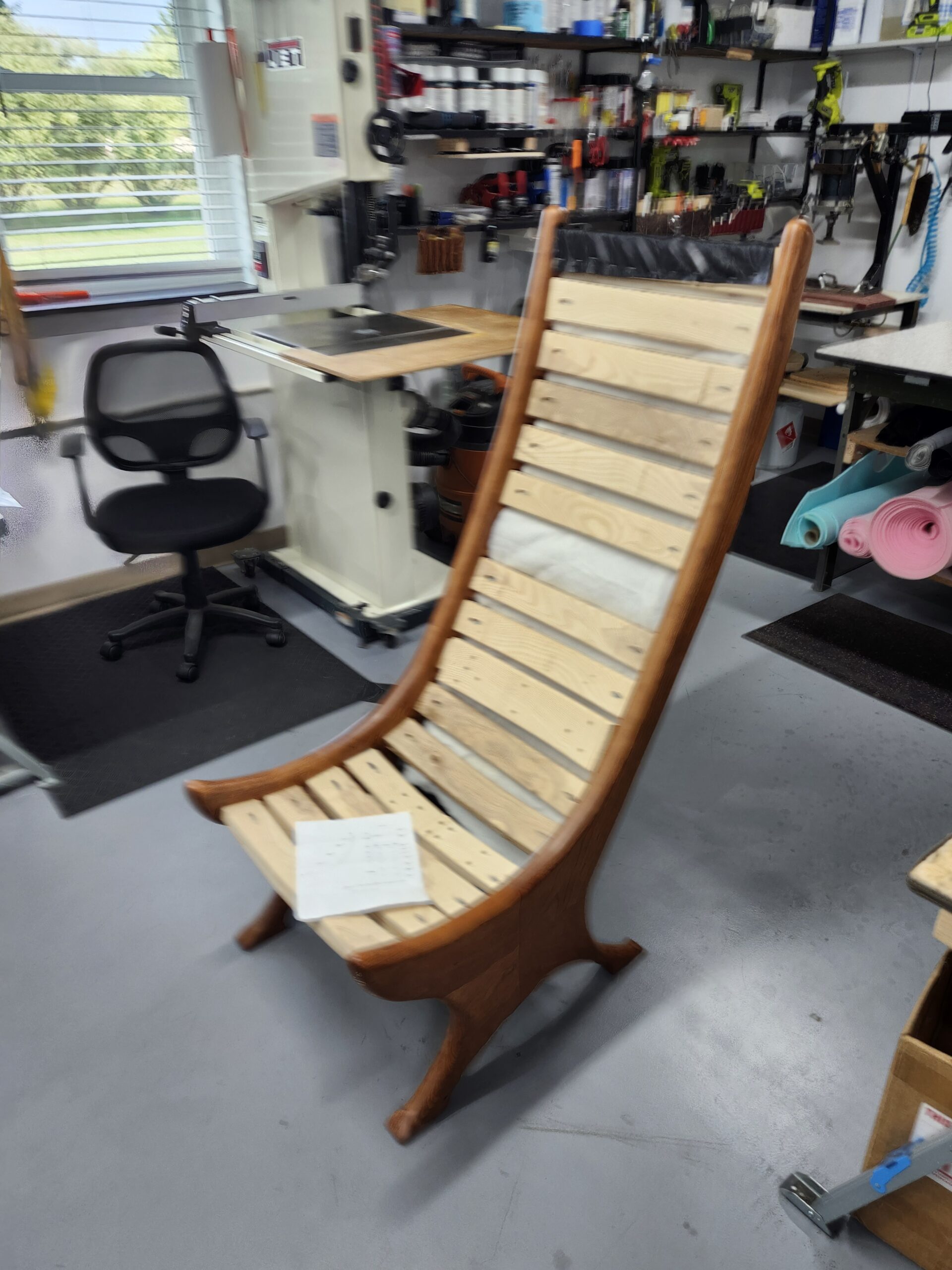
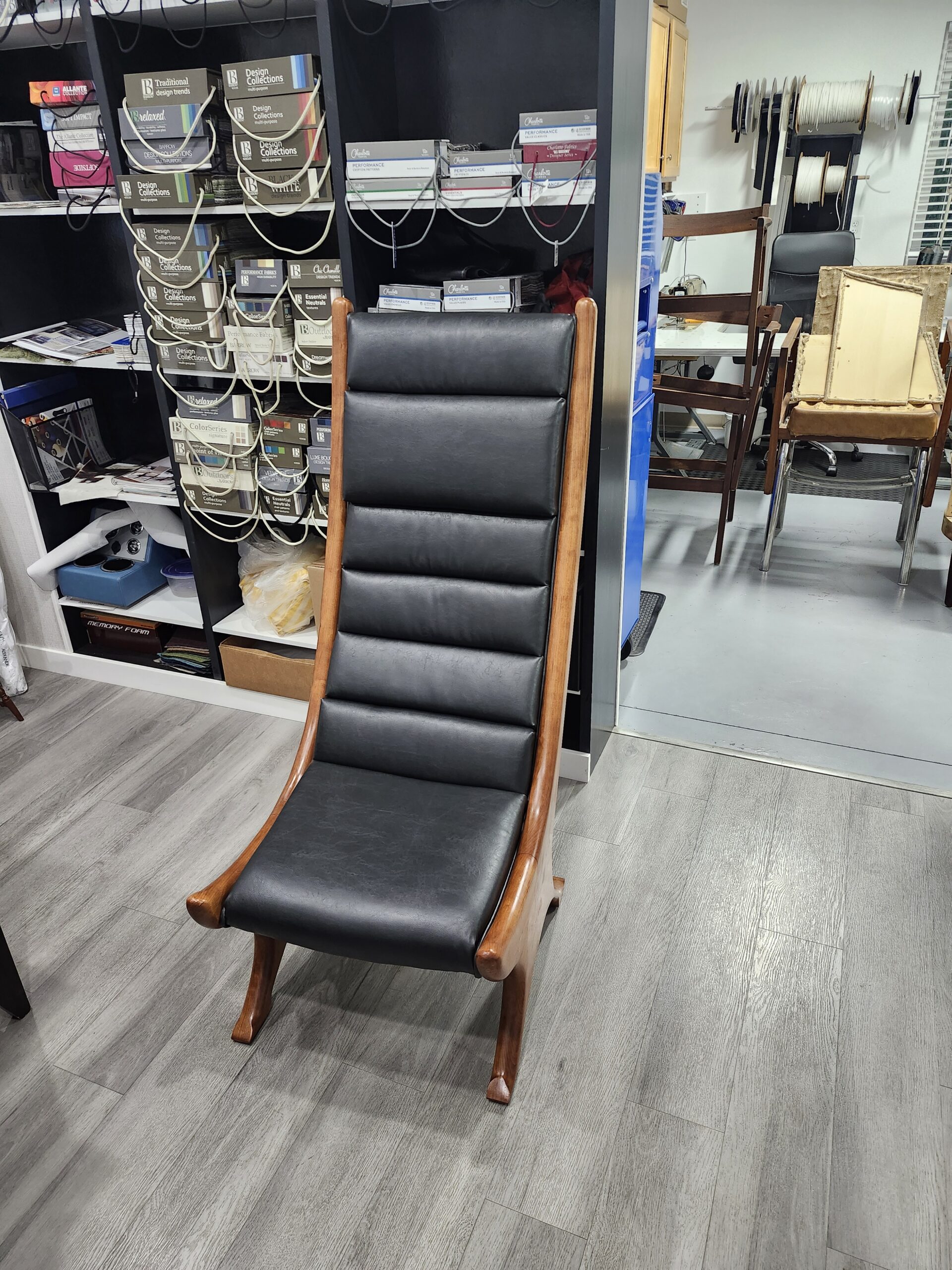
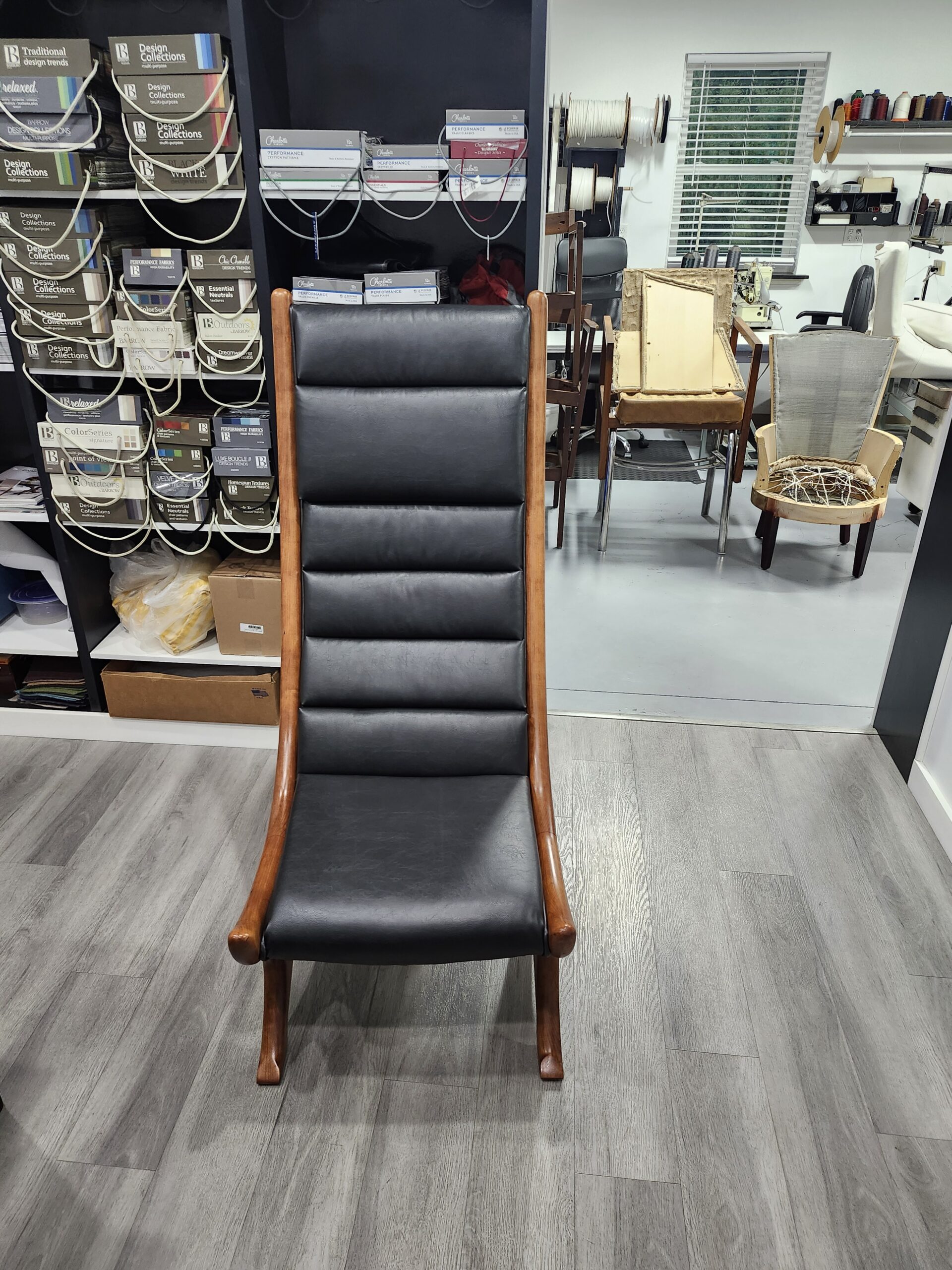
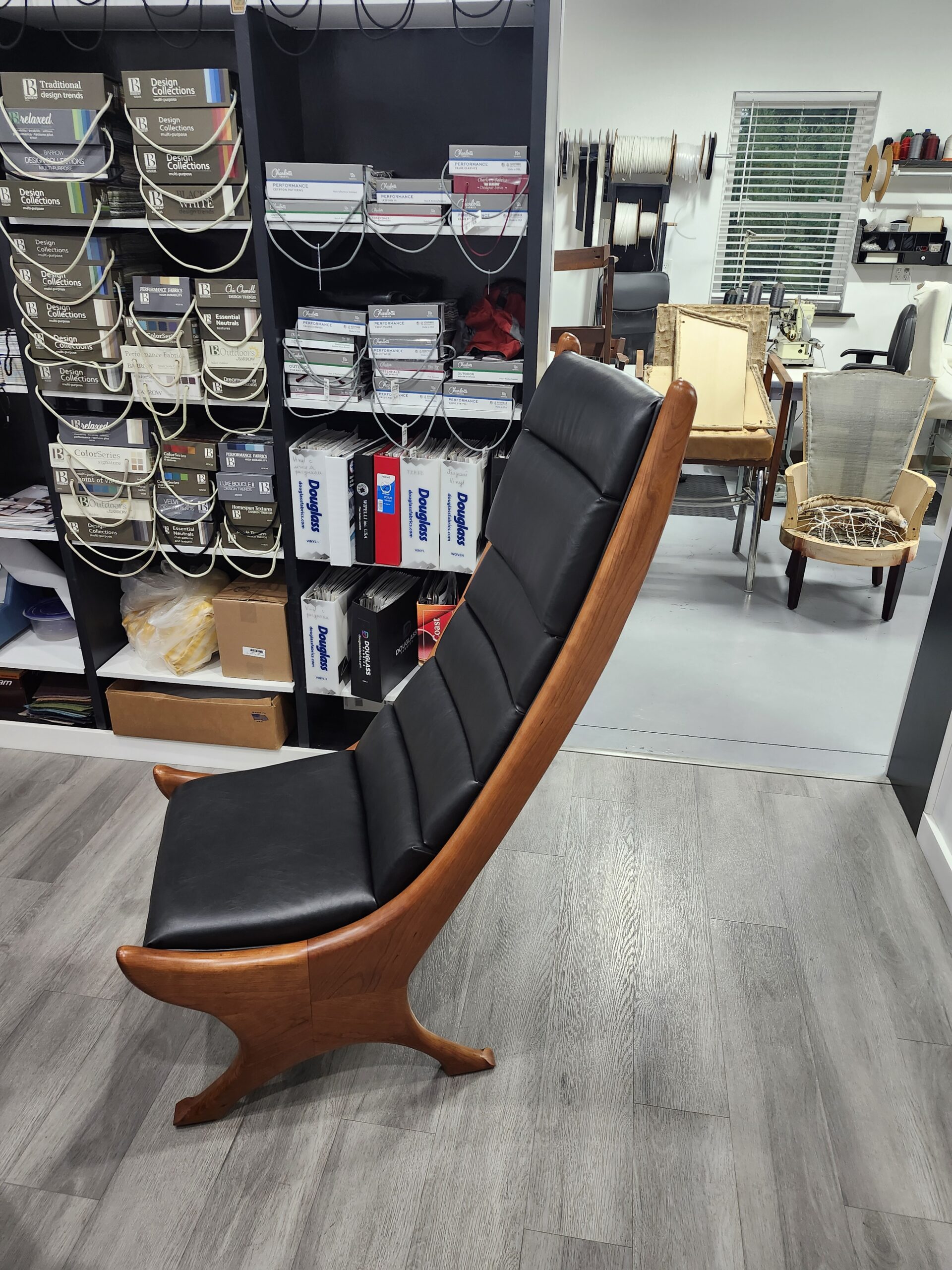
Most furniture arrives at the shop worn out. This one arrived brand new and completely bare. Two long hardwood rails, bent and sculpted into a single dramatic curve that starts at the floor, scoops through the seat, and climbs into a back tall enough to shade your ears. Across those rails, a deck of fresh wooden slats, still showing their screw heads, with a paper pattern resting on the seat. A piece of studio furniture in the mid-century spirit, built by hand, and delivered to us with one open question: what should it wear?
If you searched for custom leather chair upholstery Philadelphia PA and landed here, this is exactly the kind of project we take on. There was no old cover to copy, no staple holes to follow, no factory spec sheet. Our furniture upholstery service usually starts by taking something apart. This time it started with a blank frame and a promise: the wood stays the star, and everything we add has to earn its place on that curve.
Custom Leather Chair Upholstery Philadelphia PA: Starting From Bare Slats
Reupholstery is archaeology. You peel back layers, read what the last upholsterer did, and rebuild it better. A chair that has never been upholstered is a different animal entirely. There is no map. Every decision, from how thick the padding sits to where the first seam lands, has to be designed from scratch and tested against the frame in front of you.
And this frame did not make it easy. The back is not a flat panel; it is a long sweeping curve that changes angle from the crown to the seat. The seat is not a box; it flows out of the same curve and dies into the front edge. The sculpted rails sit proud on both sides, which means the upholstery cannot simply wrap around and hide its edges the way it does on a fully covered chair. Every border would stay visible, inches from the wood, for the life of the piece. That is the kind of build where the difference between careful and casual shows forever.
Inside the Build: From Slat Deck to Channeled Black Leather
The Padding Architecture
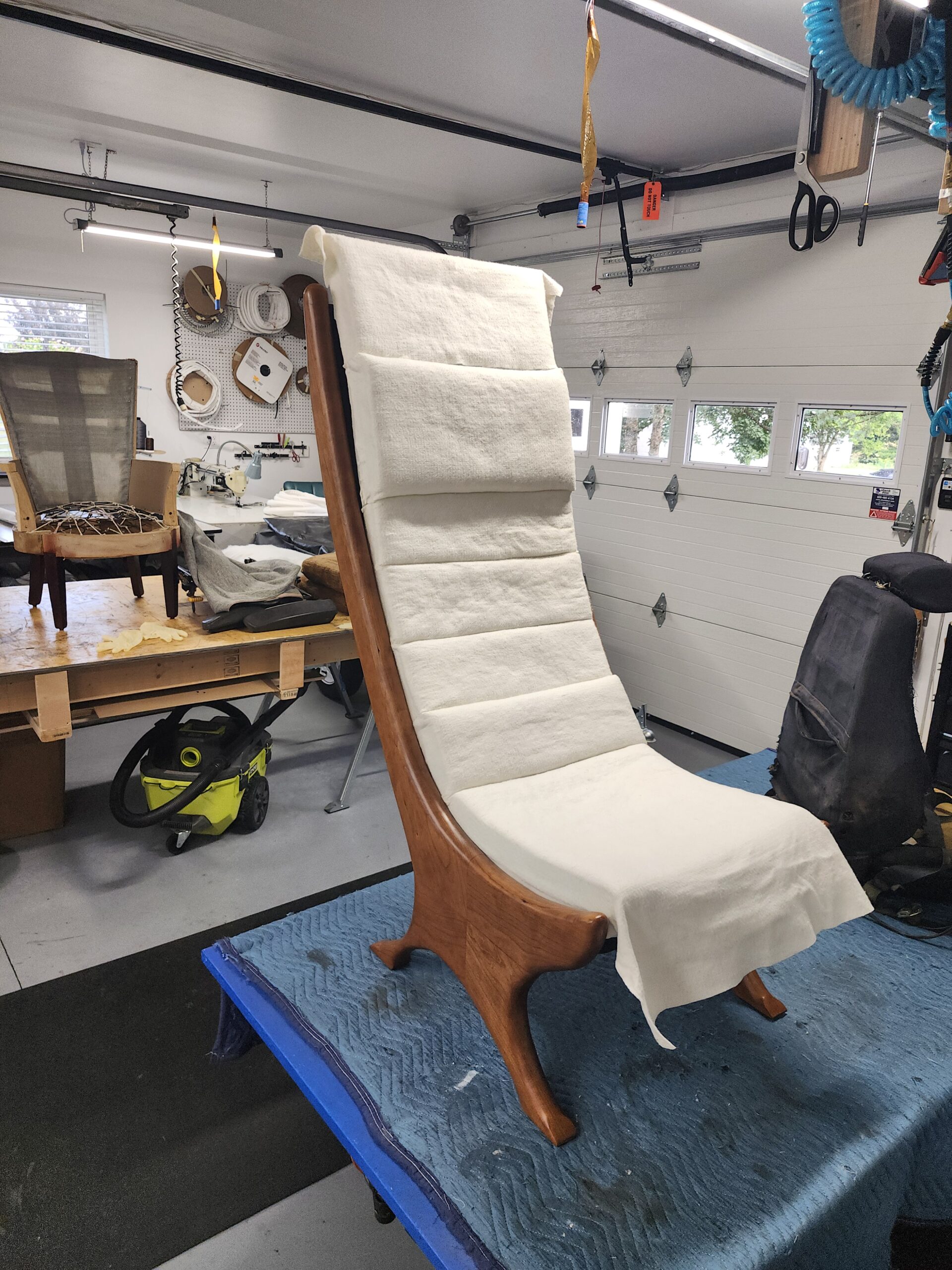
The wooden slats are the foundation, and they are a good one: they give a touch of flex across the whole deck instead of the dead feel of a plywood shell. On top of them we built the padding in graded layers of high-density foam, firmer through the seat where your weight concentrates, softer up the back where you want the chair to receive you rather than push back. Polyester batting over the foam rounds the edges so nothing reads boxy, and the whole stack was dry fitted in white first, section by section, before any leather was cut. That white stage in the photo is not filler; it is the blueprint the finished chair is built on.
Six Channels, One Curve
The back is divided into six horizontal channels, each one a separate padded cell fitted to its own station on the curve. On a spine this dramatic, one big padded slab is a slow-motion failure: the filling migrates downhill, the cover loosens where the curve is tightest, and within a couple of years the chair looks tired. Channels solve all of that. Each seam anchors the leather to the padding at a fixed line, so the material stays put, the profile stays crisp, and the horizontal rhythm plays beautifully against the vertical sweep of the rails. Every channel was sewn on our walking-foot Consew machines, which feed thick leather evenly instead of stretching the top layer the way a home machine would.
The Leather
The cover is top-grain leather in black, supple enough to sew into tight channels but tough enough for a chair you actually live in. On a high-contact piece like a lounge chair, real hide earns its keep: it burnishes with use instead of flaking, and it takes on character exactly where hands and shoulders touch it. We keep an eye on how our hides are sourced, which is why organizations like the Leather Working Group, which audits tanneries on environmental practice, matter when we choose suppliers. There are honest cases where synthetics win, and we wrote up the trade-offs in our piece on faux leather as an upholstery material. For a hand-built frame meant to outlive its maker, this was not one of those cases.
Tension Over the Spine
The hardest part of the whole build is invisible when it is done right: keeping leather taut over a surface that curves in two directions. Pull too hard and the channels flatten and the hide ripples at the transitions. Pull too little and the back looks deflated within a season. Each channel was tensioned individually, worked from the center out, and checked against the rails so the padded body follows the bend of the wood like it grew there. More projects in this vein live on our leather work page, but this frame was the best argument for the craft we have had in a while.
Shop note: if you are a woodworker or a maker who builds frames and stops at the slats, that is not an unfinished project. That is a handoff. Bring us the frame and your ideas, and we will engineer the padding and cover the same way we did here, without a single unnecessary staple in your woodwork.
"The wood was always the star. Our job was to dress it, not to hide it behind a costume."Alex Levchuk, Alex Upholstery Shop
| Spec | Detail |
|---|---|
| PIECE | Studio-crafted sculptural high-back lounge chair, mid-century spirit |
| FRAME | Bent and sculpted hardwood rails with a wooden slat deck, delivered bare |
| SCOPE | Full first-time upholstery: padding architecture, cover design, channeled leather |
| PADDING | Graded high-density foam over the slat deck, polyester batting wrap, white dry fit |
| COVER | Top-grain leather, black, sewn into six horizontal channels |
| SEWING | Walking-foot Consew machines, channels tensioned individually over the curve |
| DESIGN RULE | Exposed wood rails stay the star; upholstery follows the frame, never fights it |
Options for Custom Leather Chair Upholstery Philadelphia PA and Beyond
Philadelphia is full of people who make things: furniture studios in Fishtown, woodshops in Kensington, design collectors hunting mid-century pieces on Antique Row. What the city has less of is upholsterers eager to take on one-off frames with no instructions. We are based in Myerstown, about ninety minutes west on the turnpike, and we regularly serve Philadelphia and beyond. Some clients drive the frame out; many start with photos and measurements and never make a wasted trip. That mix is why custom leather chair upholstery Philadelphia PA searches keep landing on a workshop in Lebanon County.
For a build like this one, the choices are yours to make:
- Cover material: top-grain leather in a range of colors and finishes, protected hides for heavy daily use, or performance fabrics where leather is not the right call
- Channel layout: horizontal bands like this chair, vertical channels, biscuit patterns, or a single clean slab where the frame suits it
- Padding level: from a thin tailored profile that shows off the frame to a deep lounge build for long sitting
- Scope: first-time upholstery on new frames, full strip-and-rebuild on existing chairs, or padding-only refreshes under a cover worth saving
- Matching pieces: ottomans, benches, and companion cushions built to the same spec
No two frames are alike, so we do not price from a menu. Every job is quoted individually after we inspect the piece, in person or from your photos, and the number comes from the person who will actually sew the channels.
Frequently Asked Questions
Yes, and it is some of our favorite work. With no old cover to copy, we design the padding and cover from scratch: templating each section on the frame, dry fitting the foam and batting in white, and only then cutting leather or fabric. New frames from woodworkers, welded steel bases, and studio prototypes are all fair game.
On a tall curved back, a single slab of padding slowly fails: the filling migrates downward, the cover loosens at the tightest part of the curve, and the profile sags. Channels anchor the leather to the padding at every seam, so each cell holds its shape and position for years. On this frame they also add a horizontal rhythm that flatters the vertical sweep of the wood.
For high-contact seating we usually recommend top-grain leather with a protected finish. It resists scuffs and body oils, wipes clean, and develops character instead of wearing out where you touch it most. Pure aniline hides look gorgeous but show every mark, so we reserve them for lower-traffic pieces. We walk you through samples before anything is ordered.
A first-time upholstery build typically runs a few weeks from the day the leather arrives, because the design and dry-fit stages come before any sewing. This chair went from bare slats to finished channels in about two weeks in the shop. You get a realistic timeline with your quote, and we would rather beat it than break it.
Dust along the seams with a soft brush or vacuum attachment so grit does not settle into the channels, wipe with a barely damp cloth as needed, and condition the leather once or twice a year. Keep the chair out of direct sunlight and away from heat vents, which dry leather faster than use ever will.
More Work from the Shop
Other leather and custom builds that made the trip to Myerstown worth it.
Built Something That Deserves Real Leather?
Send a few photos and rough measurements. You will get a straight answer and a real quote from Alex, the same person who will sew your channels. Serving Philadelphia PA, all of Pennsylvania, and the Northeast.