


Project Details. Upholstery Chevy 1952 2 door deluxe
- Project: upholstery Chevy 1952 2 door deluxe
- Category: antique and classic car
- Our Task update design for
Chevy 1952 2 door deluxe.



A 1952 Chevy Deluxe two door has a way of collecting an audience at a gas pump. It is not flashy the way a muscle car is flashy. It is round, honest, postwar iron, the car a whole generation learned to drive in. When one rolls into our lot, work in the shop slows down for a few minutes and nobody apologizes for it.
The owners who bring us these cars almost never bought them on a whim. It was grandpa’s car, or the same model dad drove, or a twenty year search finally paid off. The body and drivetrain usually get sorted first, and then the owner opens the door, looks at a split bench seat leaking cotton, and calls us.
The early fifties were the last stretch when American car interiors were built like furniture. Chevrolet was selling comfort to families, so the Deluxe got a broad bench, deep cushions, and cloth trimmed in a way that would look at home on a parlor sofa. There is a reason our shop moves so easily between houses and garages. The trades were the same trade back then, and the different types of furniture restoration work we do use skills that came straight out of that era.
These cabins were sewn by trimmers, not assembled from molded plastic. Panels were cut from cloth and vinyl, stitched into pleated faces, and stretched over real spring foundations by hand. That is exactly why a seventy year old Chevy seat can be rebuilt at all. There is nothing in it we cannot make again.
A quick identification note, since these cars wore several names. Chevrolet split the line into Special and Deluxe trim, and body styles into the notchback Styleline and the fastback Fleetline. Deluxe meant the dressier cabin: brighter garnish moldings, richer cloth, more pattern in the seat inserts. When we research material for one of these, the trim tag and those small badges tell us what the interior is supposed to be, which keeps a restoration from drifting into guesswork.
Strip the cover off one of these benches and you find a steel frame carrying dozens of coil springs, tied and clipped into a unit, sometimes called a Marshall unit or spring bank. Over the springs sits burlap, then a mat of cotton batting, sometimes with a horsehair layer in nicer trim levels. The cover is fitted over all of it and secured with hog rings, hundreds of them, twisted onto wire listings sewn into the cover itself.
No molded foam bun, no plastic clips. Every layer does a job. The burlap keeps the cotton out of the springs, the cotton spreads the load, and the pleats in the cover are not decoration. They control fullness so the face of the seat stays smooth while the cushion flexes underneath.
Around the perimeter of the cushion runs a border wire that gives the seat its crisp front edge, and the cover’s listing wires hog ring to the springs deep inside the cushion so the pleats stay put when a passenger slides across. Even the seat back follows the same recipe at a lighter weight. It is a system, and every part of it was designed to be serviced with hand tools.
That construction gives these seats their trademark ride, a soft settle followed by real support. Modern foam cannot quite fake it, which matters when we decide how to rebuild.
Cotton batting compresses and migrates, so the bench develops valleys where drivers sat and a ridge in the middle nobody used. Burlap dry rots and lets springs poke through, which is when owners notice a distinct twang on bumps. The spring banks themselves usually survive, though we find broken ties, loose clips, and rust where a window was left cracked in the rain.
Covers fail along stress lines. The driver’s entry corner goes first, then the top of the seat back where sun comes through the glass. Mice are the wild card. A car stored in a barn for even a couple of winters can look fine outside and be hollowed out inside. None of this scares us, and none of it means the seat is beyond saving. It almost never is.
We start by photographing and taking apart the original, because the old cover is a document. Seam placement, pleat count, listing locations, the way the corners were finished, all of it gets recorded before anything is thrown away. Then the frame and springs get cleaned, repaired, and retied where the old ties let go. If a spring bank is genuinely done, we rebuild the foundation, but our first instinct is always to preserve what the factory did well.
Padding is a judgment call we walk through with each owner. A show car pointed at judged events gets cotton over burlap, just like 1952. A car that drives every weekend often gets a hybrid, traditional materials where they show and a thin foam layer where it buys years of shape retention. Neither answer is wrong. The wrong answer is not asking the question.
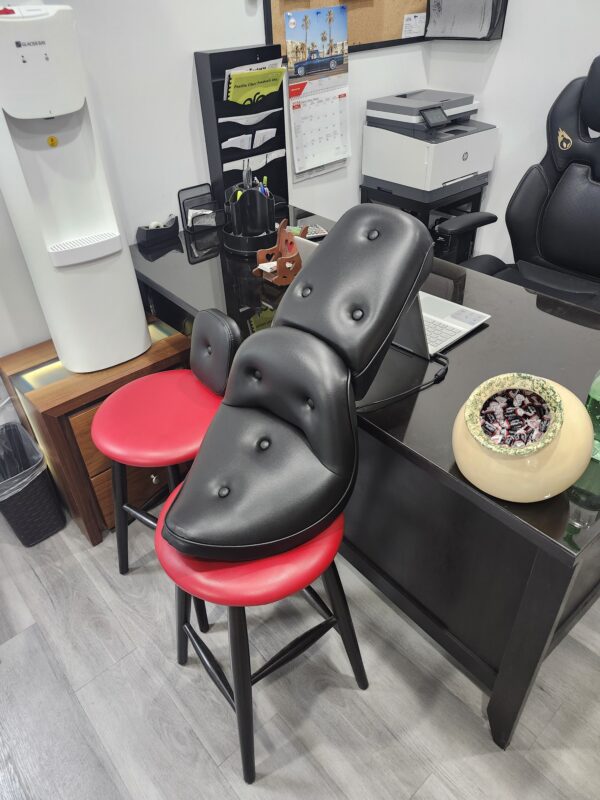
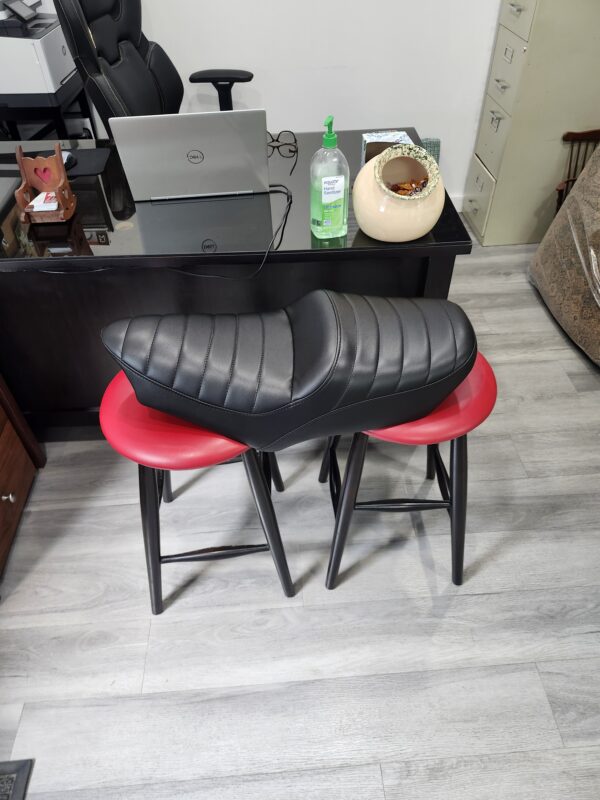
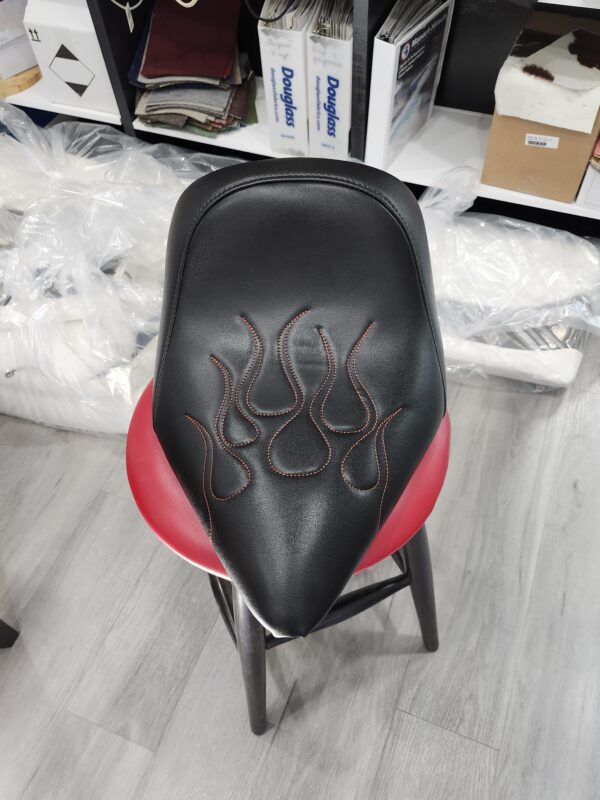
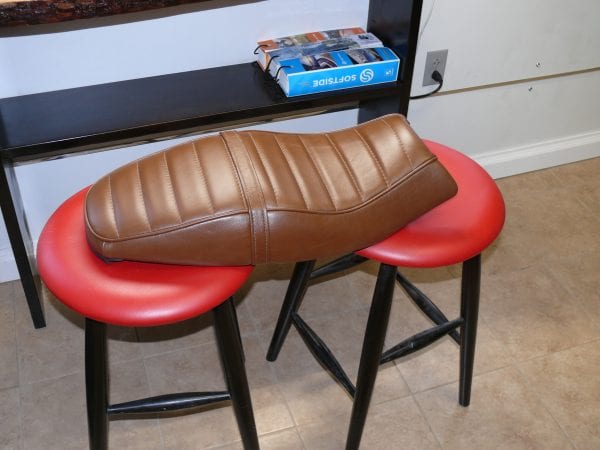
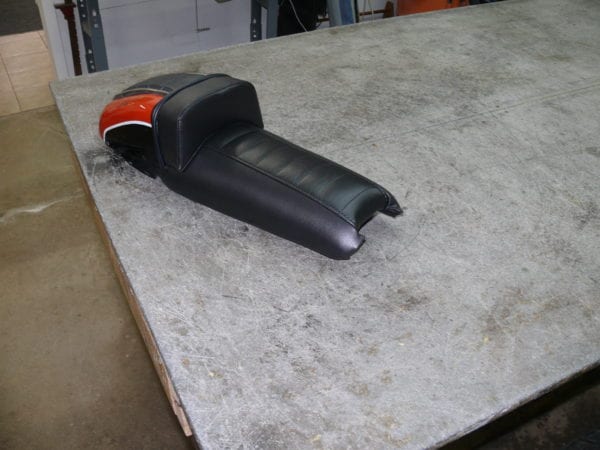
Then the new cover gets cut and sewn. Long straight pleat runs on a bench this size are unforgiving, since every wobble shows across four feet of seat. It is the same discipline at a different scale from a black leather motorcycle saddle we built, where a single seam sits six inches from the rider’s eye. Hundreds of fresh hog rings later, the bench goes back on its tracks, and this is the moment in our auto upholstery work that never gets old.
Chevrolet trimmed these cars in patterned broadcloth and vinyl combinations, and for a faithful restoration we hunt down reproduction material that matches the original weave and pattern as closely as the market allows. For drivers, modern vinyl is a sleeper choice, tougher than the original and correct looking, and faux leather material has come a long way from the sticky stuff of decades past.
Then there is real leather, which was not factory trim on a Deluxe but wins hearts anyway. Done in a period sympathetic color with correct pleats, a leather bench looks like something Chevrolet could have offered and simply did not. We cut around scars and brand marks, match hides across the bench so the grain reads as one piece, and sew with the same care you can see in the 1948 Daimler DE36 we reupholstered, a car whose whole personality lives in its hides. Swing by the shop and put your hands on the fabrics and leathers we stock before deciding. Sample cards lie less than photographs.
Color matching deserves patience too. Original broadcloth faded unevenly over the decades, so we match against a protected area, under the seat or deep inside a pleat, rather than the sun struck top surface. That is how the new interior ends up matching the car Chevrolet built rather than the car the sun made.
Sun is the main enemy, so a windshield sunshade during storage is worth more than any product in a bottle. Keep the car in a space with reasonable humidity, since a damp garage rusts springs from below while dry heat makes cotton and leather brittle from above. Vacuum cloth gently, wipe vinyl with mild soap, and condition leather a couple of times a year, lightly.
The conservation world thinks about this stuff more rigorously than anyone, and the American Institute for Conservation publishes plain language guidance on caring for treasured objects that applies beautifully to a car like this. Stable environment, gentle handling, no miracle products. Their advice, our experience, same conclusion.
One more habit worth building: crack the windows or use a breathable cover when the car sits for months at a stretch. Trapped cabin moisture condenses on glass and steel and finds its way into the cotton under the covers, and a musty interior is far easier to prevent than to cure.
Yes, at least until the job is done. Original covers carry the pattern, the pleat spacing, and the trim details, and they settle arguments about what is correct. Some owners keep them afterward as part of the car’s paper trail, and we think that is a fine habit.
It is not factory correct, so a judged show car should stay with reproduction cloth and vinyl. For everyone else, it is your car. A tasteful leather interior in a period appropriate color is a choice plenty of owners never regret.
It can be fixed, but not in isolation. Retying one section changes how the whole bank carries weight, so we go through the full foundation while the seat is open. Doing it once, properly, is what keeps the bench comfortable for decades.
If your Deluxe deserves a bench as good as its paint, we would love to see it. Browse our leather work gallery for ideas, then request a quote or call 717-383-6917 and tell us what is under those seat covers.
 Get a Free Quote!