


- Project: Reupholstery
- Category: Upholstery
Our Task
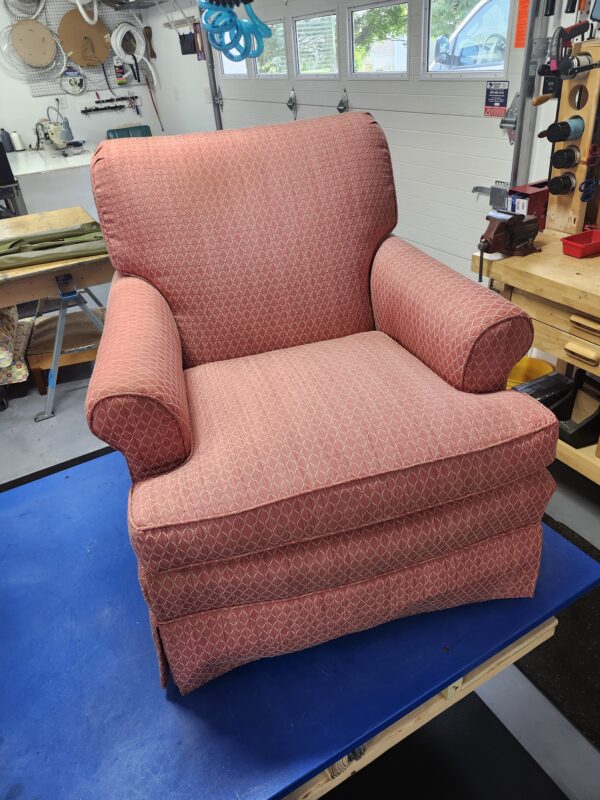
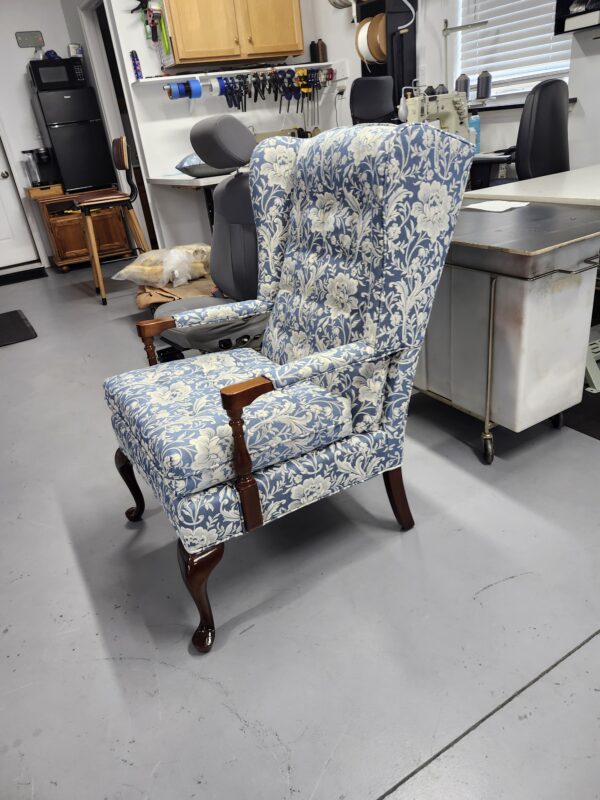
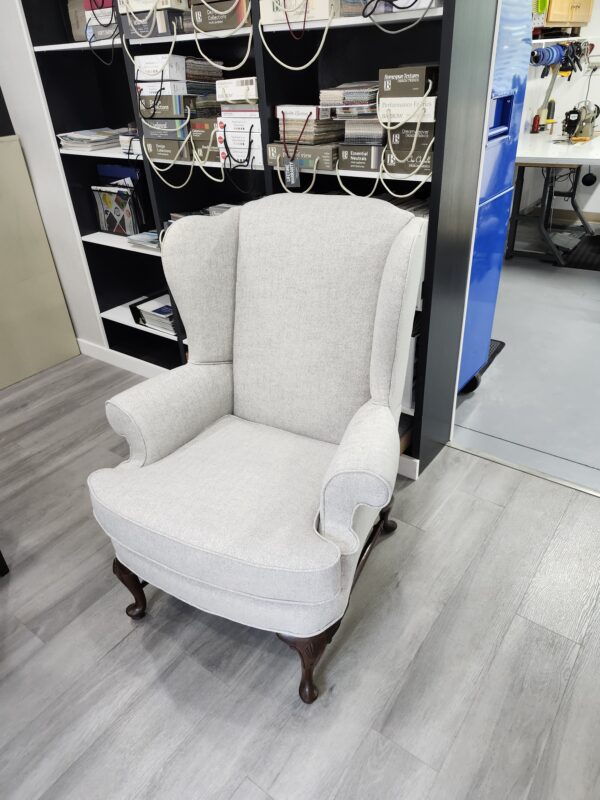
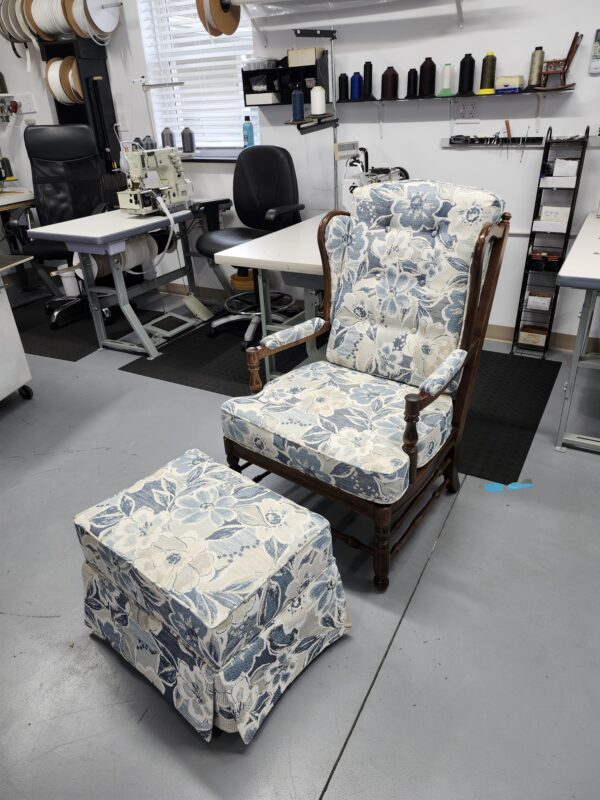
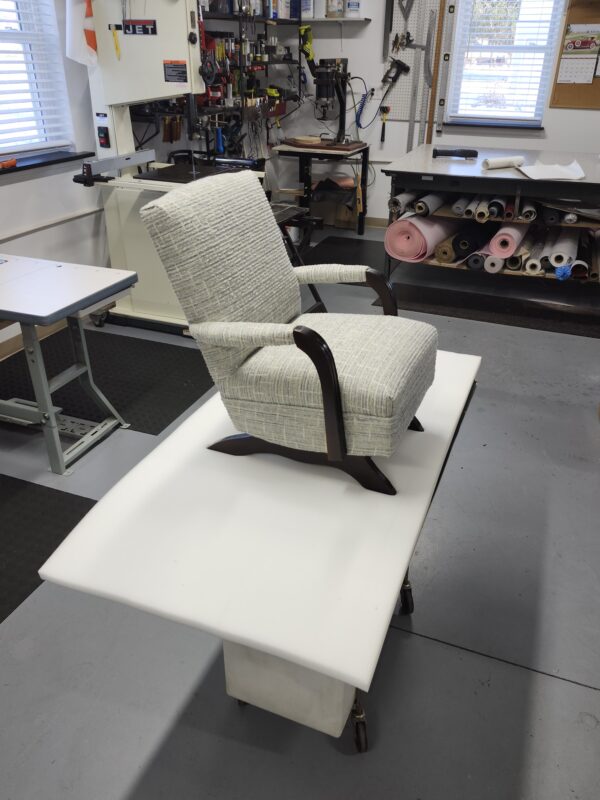
Complete Reupholstery with stripe fabric



Complete Reupholstery with stripe fabric
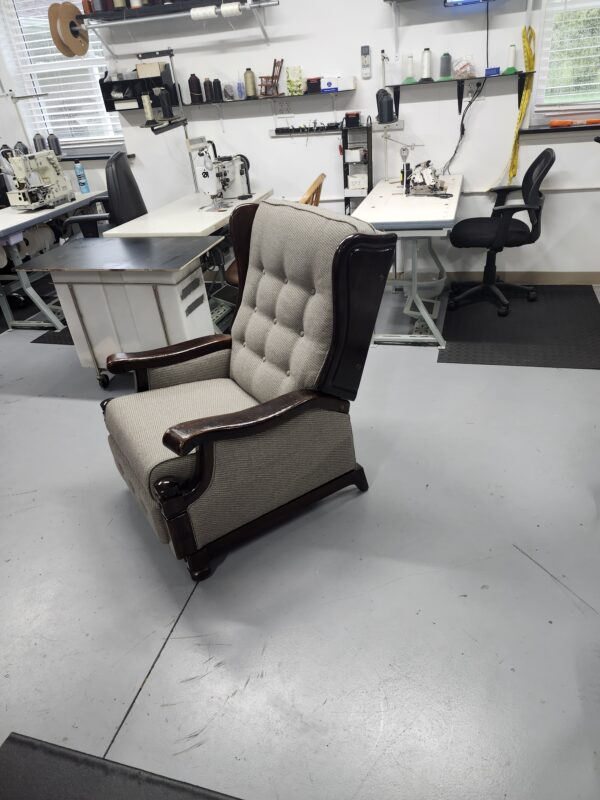
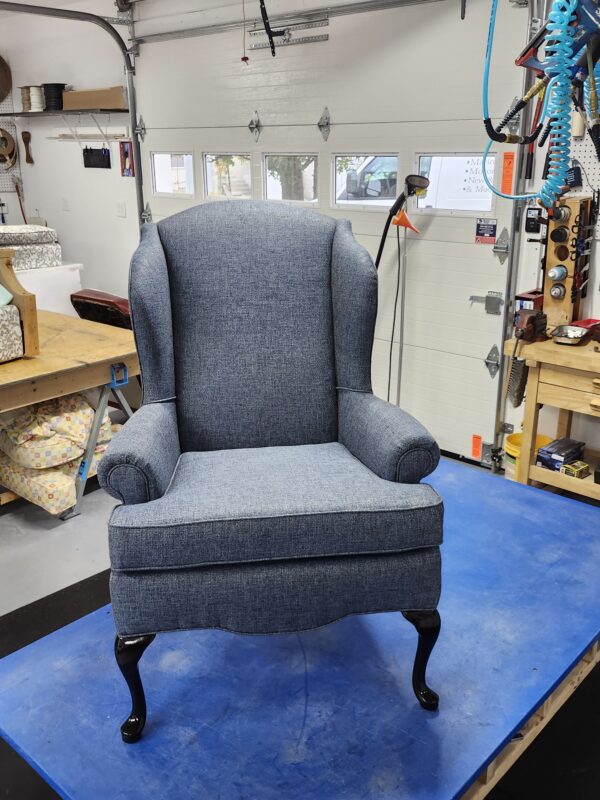
Some chairs whisper and some chairs pinstripe. When a wingback with padded armrests goes out our door wearing a crisp stripe, it reminds us why striped fabric has stayed in the upholsterer’s toolkit for two hundred years: nothing else gives a traditional frame that much snap while staying completely civilized.
Stripes are also the least forgiving choice an owner can make. Every line reports on the cutter’s accuracy. A quarter inch of drift at a seam and the whole chair looks like it is leaning into the wind. This article is about what it takes to do stripes properly on a winged frame, and what has to happen to the chair underneath before the first panel is ever cut.
Striped upholstery had its first great run in the decades around 1800, when neoclassical taste swept the drawing rooms and silk stripes replaced the heavier damasks of the previous generation. Regency England and Federal America both loved the look: disciplined, architectural, a little optimistic. Wingback frames, already a century old by then, took to stripes naturally, because the chair itself is architectural, all verticals and returns.
Browse the Victoria and Albert Museum furniture collection and you will find period seat furniture wearing exactly this pairing, which should comfort anyone worried that stripes on a traditional frame are some modern liberty. They are not. A good stripe is one of the most historically grounded choices you can make for a chair like this.
Stripes also do something practical: they emphasize height. A wingback already stands tall, and a vertical stripe stretches it further, which flatters rooms with high ceilings and gives smaller rooms a welcome sense of lift.
Fabric is the last chapter of any project, and before we get there the chair tells its story in layers. Under a worn cover we typically find several previous recovers stacked like sediment, each one tacked over the last. Seat rails split when this happens too many times, so part of every teardown is pulling hundreds of old tacks and staples and judging what the wood underneath can still hold.
Deeper in, the usual suspects: webbing gone slack, coil springs leaning out of line, burlap gone brittle, stuffing packed hard where seat bones and forearms concentrated fifty years of use. Now and then we find water staining from a window left open or a basement mishap, and owners are often surprised how much can still be done; we covered that ground in our post on when flood damaged furniture can be saved.
None of it changes the plan. It just determines how much rebuilding happens before the fabric conversation gets serious.
Here is the discipline stripes demand. Every panel on the chair must be cut with the dominant stripe centered and plumb: inside back, seat, cushion, outside back, each referenced to a centerline marked on the frame itself. The stripes on the seat should run into the stripes on the inside back as if the fabric flowed through the chair, and the cushion has to land so its lines continue the seat’s rhythm in both directions.
Arms are the test. An upholstered armrest rolls fabric through a compound curve, and a stripe will happily bend into a banana if the cutter ignores grain and tension. We cut arms in mirrored pairs, keep the stripe plumb at the front where the eye checks it, and let the unavoidable distortion hide on the outside faces where nobody looks. Welt cord gets its own decision: cut along a single stripe color so it reads as a clean pinline, or cut on the bias for a barber pole effect at the edges. Both are legitimate. Mixing them on one chair is not.
There is also the question of direction. Most stripes are woven to run up the roll, but some fabrics can be railroaded, turned sideways so the stripe runs along the roll instead. On a wingback that decision touches every panel: railroading can save yardage on wide outside backs but forces seams elsewhere, and on the inside back it would turn your vertical stripes horizontal. We work this out on paper before the fabric is even ordered, because it changes both the look and the math.
Matching of this kind takes more yardage than a solid either way, and it takes honest arithmetic up front. We measure the chair, map the fabric repeat, and tell you exactly how much the job wants before anything gets ordered.
A crisp stripe over a bad foundation is lipstick. Our sequence never changes: frame, suspension, padding, then fabric. Joints get reglued and clamped square, because a frame that racks will shear a stripe out of line within a year. Webbing and springs get renewed or retied so the seat crowns properly and holds its shape. Padding gets rebuilt to the original profile, with sound original hair saved, new cotton over it, and a muslin undercover pulled tight to prove every line before the show fabric comes near the chair. That foundation work is the core of our antique restoration service, and it is not optional.
We hold the same standard on every traditional piece, from the Chippendale loveseat sofa we reupholstered to an antique Italian Victorian dining chair set whose seats all had to be rebuilt to match one another. Dining chairs are actually a fine miniature of the whole craft; our guide on how to completely recover a dining chair shows the layer by layer logic that scales straight up to a wingback.
And if you enjoy seeing how the work actually happens, you are welcome to tour our shop. The cutting table where stripes get their discipline is usually the favorite stop.
Scale first. A wide two tone stripe reads formal and calm. A narrow ticking stripe reads relaxed and cottage. A multicolor Regency stripe splits the difference and hides everyday wear beautifully. Always hold a full width of fabric against the chair rather than a two inch swatch, because stripes change character entirely at scale.
Fiber second. Period silks are gorgeous and fragile. Modern performance weaves now come in convincing traditional stripes with wear ratings that shrug off daily use, so for a chair that will actually get sat in, we usually steer owners toward a tightly woven blend in a period pattern: the look of 1810 with the durability of now.
Color last. Pull one tone from the room’s rug or drapery so the chair joins the conversation instead of interrupting it. Then trust the frame. A wingback has carried stripes for two centuries and knows exactly how to wear them.
A striped chair has one aftercare quirk all its own: fade shows on it faster than on any solid. Sunlight will soften one flank of the chair while the shaded side keeps its full color, and on a stripe the mismatch is obvious from across the room. Position the chair out of direct sun, or filter the window with a sheer or a UV film, and give the chair a quarter turn now and then so light falls evenly over time.
The rest is standard good housekeeping for upholstered antiques. Vacuum monthly with a soft brush to keep grit from sawing at the fibers, and flip and rotate the seat cushion so the crush spreads evenly instead of parking in one spot. Blot spills immediately with a white cloth; rubbing drives the stain in and can burnish the pile of a woven stripe. Keep indoor humidity moderate and steady, which protects the reglued frame as much as the fabric.
Treated this way, a quality striped cover will hold its lines and its color for decades, and the frame underneath, having been properly rebuilt, will be ready for the next fabric when the day finally comes.
Yes, and planning for it up front avoids disappointment later. Centering and matching stripes across panels creates cutting waste a solid never has, especially on a chair with a loose cushion. We calculate exact yardage from the repeat before you commit to a single yard.
That alignment is the whole job, and yes. Each panel is cut from a common centerline so the stripe appears to travel through the chair unbroken. Where compound curves force distortion, we place it where the eye does not go.
We would rather not, and we will tell you why honestly: a racking frame ruins new fabric fast, and stripes advertise the ruin faster than anything else. Regluing first protects everything you are spending on the cover. It is the difference between a chair that looks right for a year and one that looks right for thirty.
Thinking about a stripe, or any new life for a tired wingback? Send photos through our quote request page or call 717-383-6917 and we will talk it through. Every piece is quoted individually after inspection, and honest advice costs nothing.
 Get a Free Quote!