


Project Details
- Project: Upholstery Uhuru Design
Bandholz Chair - Category: Furniture Upholstery
Our Task
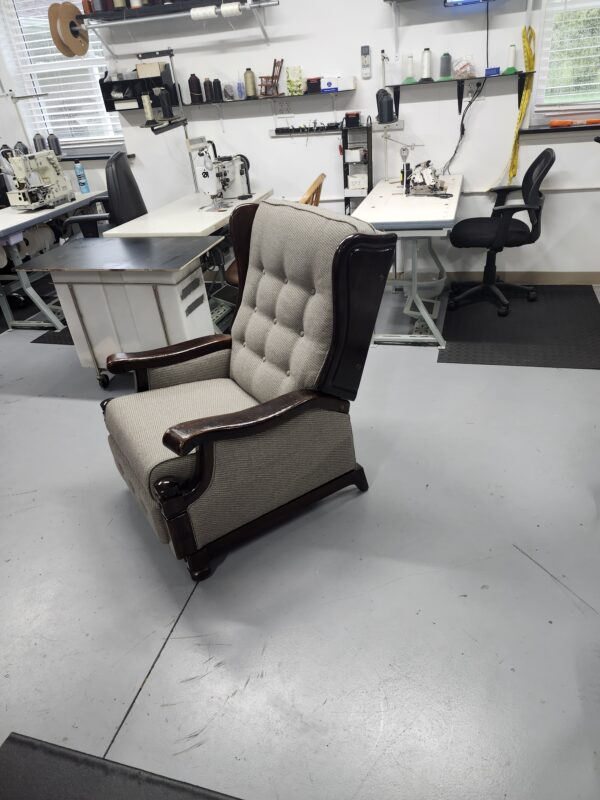
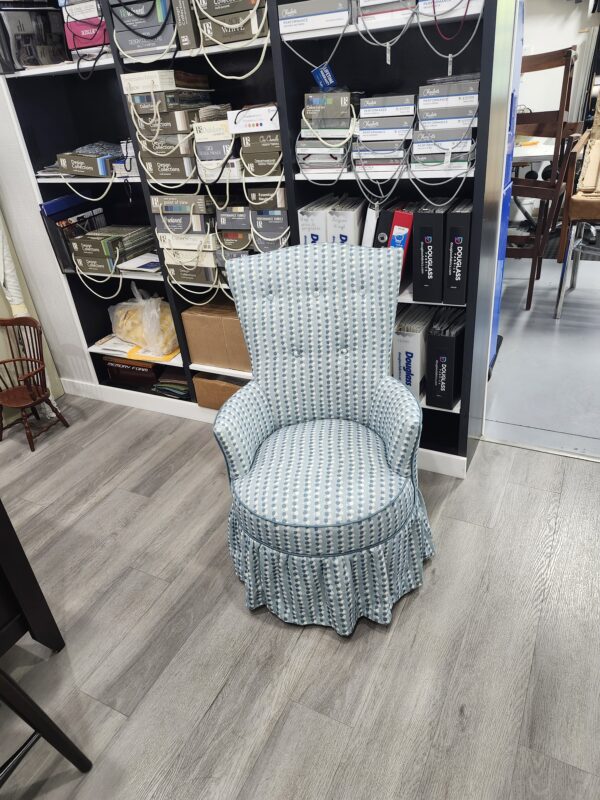
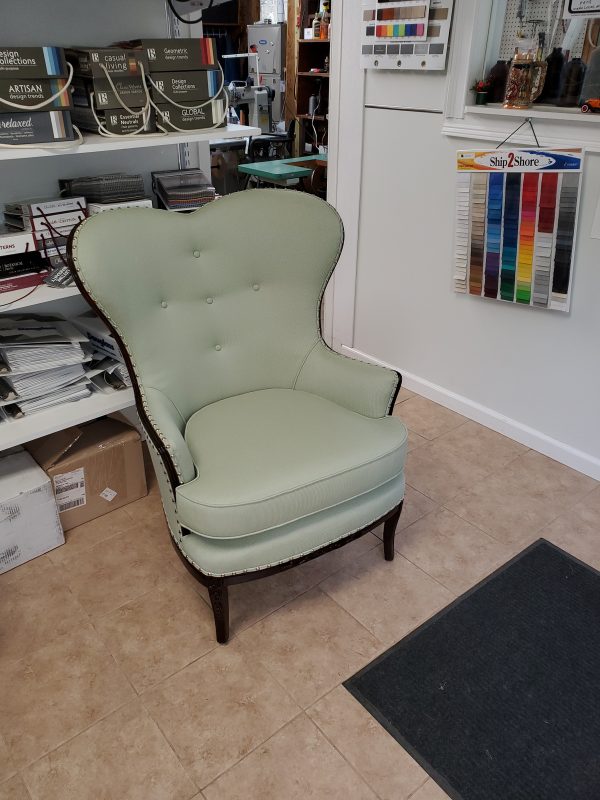
Upholstery new Bandholz Chair.


Upholstery new Bandholz Chair.
There is a habit of thinking that says restoration shops are only for furniture with a century on the clock. We disagree, and the Uhuru Design Bandholz chair makes the argument for us. Uhuru is a Brooklyn studio that built its reputation on salvaged materials and uncompromising craft, and a chair like this is made with the same seriousness as the antiques on our benches. It is a future antique that happens to be young.
Owners of studio furniture feel this instinctively. They did not buy a commodity; they bought a specific object from specific hands. So when the upholstery wears or a cushion goes flat, the right response is the same one a Victorian parlor chair gets: skilled, respectful work that keeps the piece in service for the next several decades.
Strip away the style differences and a well made modern chair shares its virtues with a well made old one. Solid hardwood or honest steel in the frame. Joinery designed to be loaded, not merely assembled. Upholstery treated as a designed element rather than a cover up. Uhuru’s work adds its own signature on top: reclaimed timber with real history in it, exposed structure, and details that reward a second look.
What modern pieces usually do not share with antiques is the suspension and stuffing. Instead of hand tied coil springs and horsehair, you will typically find elastic webbing or sinuous springs and engineered foam cores. Neither is a flaw; it is simply the contemporary vocabulary. But those materials age on their own schedule, and they are exactly the parts that bring a designer chair to our door.
The silhouette is the other thing worth naming. A studio chair earns its presence through proportion: the height of the seat, the rake of the back, the crispness of an edge. Upholstery work that thickens a cushion by an inch or softens a corner that was drawn sharp changes the design itself. We measure the original profile and hold to it, because the maker already did the hard thinking.
Foam goes first, and it goes quietly. Seat cushions lose resilience years before they look damaged, so owners adapt to a slow decline without noticing, right up until they sit in a newer chair and remember what support felt like. Elastic webbing stretches and sags. Leather picks up scuffs and dry patches, fabric pills and thins at the arms, and sunlight fades whatever it touches, modern or not.
Frames, in our experience with studio furniture, mostly hold. Occasionally a glue joint opens or a fastener backs out, and reclaimed timber can move a little more with humidity swings than kiln fresh stock, but structural failure is rare. That ratio, durable frame and consumable soft goods, is the very definition of a piece worth reupholstering instead of replacing.
Wear also concentrates in ways owners can predict once they know to look. The favorite chair in any house ages three times faster than its twin across the room, the arm nearest the side table takes the drinks and the elbows, and the cushion edge facing the television gets the perch. None of this is misuse. It is just use, and it is exactly the kind of honest wear good upholstery work erases.
The process would look familiar to anyone who has followed our antique work. Inspection first: frame, suspension, cushions, and cover, all documented before anything is disturbed. Then a careful teardown that preserves every clue about how the maker built the piece, because our job is to put it back the maker’s way, not our way. Seam placement, welt profiles, pull tension, the way a cover breaks at a corner: we record all of it.
Suspension gets renewed with materials matched to the original design. Cushion cores get rebuilt to the original geometry, with foam specified by density first and firmness second, then wrapped so the profile crowns the way the designer drew it. Covers are patterned from the originals, cut and sewn on industrial equipment, and fitted with the patience that shows up later in the finished lines. The craft is continuous across eras; a dining chair teaches the same lessons at a smaller scale, which is why our walkthrough on completely recovering a dining chair is a useful primer even for owners of modern pieces. The full menu of what we take on lives on our furniture upholstery page.
Here is the judgment call, and it is more interesting on modern furniture than people expect. On an antique, we weigh whether original horsehair and hand stitched edges should be conserved. On a studio piece, the equivalent question is about character the object has earned: the patina on a leather panel, the softened hand of a wool cover, a maker’s label stitched into a seam. Some of that is wear to be corrected. Some of it is history to be kept.
Our rule of thumb: anything that still performs and carries the piece’s identity stays. Anything that has functionally failed gets renewed in kind. Maker’s labels and markings always survive the process; we photograph them, protect them during the work, and return them to their place. That standard mirrors what the conservation field applies to objects of every age, and the American Institute for Conservation publishes accessible guidance on exactly this kind of care for the things people treasure.
The same balance guided two very different neighbors of the Bandholz in our portfolio: a club chair we upholstered as part of a set, where comfort drove the choices, and the antique wingback rocker in our project gallery, where preservation led the way. Knowing which lever to pull, and when, is most of the trade. For a map of the options themselves, see our overview of which restoration service fits which piece.
Recovering a designer chair is a matching exercise even when the color changes completely. Uhuru’s palette runs to natural, matte, substantial materials: vegetable tanned and semi aniline leathers, wool blends, heavy weaves with visible texture. Drop a shiny polyester on a frame like that and the whole object goes quiet in the wrong way. We pull samples that keep faith with the original material language, then sort them by the life you actually live: kids, dogs, sun exposure, dinner parties.
Leather deserves a special word. On a chair whose designer chose leather deliberately, hide selection is design work, not shopping. Temper, thickness, grain character, and finish level all change how the chair reads across the room and how it will age in your care. We bring hides to the chair, not swatches to a counter, and the difference shows for the next twenty years.
Modern materials are forgiving, but they are not invincible, and the routine that protects a Victorian sofa protects a Brooklyn built chair just as well. Keep it out of direct sun, which fades fabric, dries leather, and can even shift the color of reclaimed timber. Hold indoor humidity moderate and steady through the seasons; salvaged wood has already lived one hard life outdoors and appreciates a calm retirement.
Give textiles a gentle monthly vacuuming with a soft brush so grit never gets the chance to grind at the fibers from inside the weave. Rotate and flip any loose cushion on the same schedule so the foam compresses evenly across its whole footprint instead of memorizing your favorite spot. Leather wants a wipe with a barely damp cloth and a sparing coat of conditioner about twice a year, more often if the room runs dry.
Spills are a speed game. Blot immediately with a clean white cloth, work from the edge of the spill toward the center, and resist every instinct to scrub. Most modern performance fabrics will release nearly anything if you get to it in the first minute or two.
Sympathetic work generally protects value; neglect is what destroys it. The market for studio furniture rewards pieces that are sound, usable, and honest about their history. Keeping original labels, matching original materials, and documenting the work all serve you well if the piece is ever appraised or sold.
Yes, and we treat feel as a specification. Foam density and firmness, wrap type, and fill weight are all chosen against the original seating experience, or adjusted deliberately if you always wished the chair sat a little firmer or softer. You get a say in the recipe before we build anything.
Not at all. The habits that antique restoration demands, patience, documentation, respect for the maker’s intent, are exactly what a studio piece deserves. Modern frames go through the same careful hands and the same unhurried bench as everything else we touch.
If a studio piece in your house has gone flat or shabby, send photos and dimensions through our quote request page, or call the shop at 717-383-6917. Every piece is quoted individually after inspection. Good furniture deserves a long life, and ours is the shop that makes sure it gets one.
 Get a Free Quote!