


Project Details
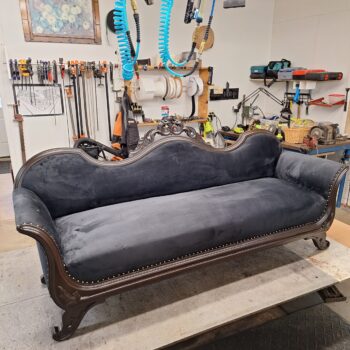
This antique Victorian box.
- Project: Upholstery for Antiques
- Category: Box Interior upholstery
Our Task
the entire interior had to be reupholstered.



This antique Victorian box.
the entire interior had to be reupholstered.
Somewhere in nearly every family there is a trunk. It sat in a grandparent’s attic, it crossed an ocean or rode a train, and now it lives at the foot of a bed holding blankets and history in equal measure. When one comes through our door, the owner almost never talks about the trunk alone. They tell us who owned it, where it traveled, and why it cannot simply be replaced with something from a big box store.
A vintage box trunk with twin leather belts is a particular pleasure for us to work on. It is furniture, luggage, and a small time capsule all at once. Here is the good news for owners: these were built to survive baggage handlers, ship holds, and horse drawn wagons. A trunk that could take that kind of abuse can usually be brought back, even after a rough century in storage.
The classic box trunk starts with a case of pine or poplar, chosen because those woods are light, stable, and easy to work. Over that box the maker wrapped a protective skin, most often canvas duck, sometimes embossed metal or leather. Then came the armor: hardwood slats running across the top and down the ends, iron or brass corner caps, and steel banding at the edges. Every one of those parts had a job, and the job was taking hits so the contents did not.
The twin leather belts that give this style its name were not decoration. Latches and locks of the era could pop open when a trunk was dropped, so makers added two full straps that wrapped the entire body and cinched down over the lid. Buckles were heavy, the leather was thick vegetable tanned hide, and the straps were anchored with rivets or stitched leather keepers.
Inside, most trunks were lined with decorative paper over muslin, and many carried a lift out tray with compartments. Groups like the Furniture History Society have done fine work documenting how travel goods like these evolved alongside household furniture, and it is striking how much engineering went into what people thought of as a disposable shipping container.
Construction details also help date a trunk. Square nails and hand hammered hardware push a piece earlier, while uniform machine screws and stamped steel fittings suggest the twentieth century. Flat topped box trunks like this one were favored by travelers who stacked luggage, since a dome top, whatever its elegance, refuses to hold a suitcase. Small clues, but they let us tell an owner more about where their trunk sits in the story.
Leather goes first. Straps spend decades flexing, drying, and absorbing whatever the attic air offers, so we usually find them cracked at the buckle holes, stiff as jerky, or missing entirely. Handles fail the same way, which is why so many old trunks arrive carried from the bottom like a sleeping toddler.
The metal tells its own story. Corner caps and banding rust wherever the plating wore through, latches seize, and locks lose their keys somewhere around 1958. On the wood side, slats crack along the grain, the thin case boards split at nail lines, and the covering lifts where glue gave up.
Then there is the interior. Old paper linings tear, stain, and hold onto a musty smell with impressive dedication. We have opened trunks that held water damage, insect evidence, and in one memorable case a mouse apartment complex, complete with what we can only describe as furnishings. All of it is fixable. None of it should scare you.
This is the heart of trunk work. A trunk that keeps its original canvas, its worn stenciling, and its honest scars keeps its story, and often its value. So our first instinct is always conservation: stabilize, clean, and preserve rather than strip and redo. When the covering is largely intact, we clean it gently, secure loose edges, and leave the patina alone.
When the original surface is truly gone, torn past saving or rotted by water, restoration becomes the kinder path. We make that call together with the owner, piece by piece, the same way we walk through options on seating projects like the pair of blue mid century chairs we brought back. If you want a deeper look at how this thinking works across different pieces, our post on how heritage furniture is restored while keeping its quality lays it out step by step.
Everything starts with inspection. We check the case for racking, probe the bottom boards, test every joint, and photograph the hardware before a single screw moves. Because no two trunks arrive with the same problems, every piece is quoted individually after we have seen what we are dealing with.
Structural work comes next. Split boards get glued and clamped, loose slats are refastened, and missing slat sections are milled from matching hardwood. Rusted hardware is removed where possible, cleaned back to sound metal, and sealed with a microcrystalline wax rather than repainted, so it still reads as old. This is the same discipline we bring to all of our antique restoration work: repair what exists, replace only what is lost.
Strap work follows. Where the twin belts can be saved, we clean and condition them and reinforce the stress points from behind. Where they cannot, we cut new straps from vegetable tanned hide in a matching weight, transfer the original buckles when they survive, and age the new leather so it does not glow like a new baseball glove next to hundred year old canvas.
Finally, the interior. Old lining comes out, the case gets deodorized and sealed, and new lining goes in, either reproduction paper or cotton fabric depending on the era and the owner’s plans. Plenty of clients ask us to build a fitted padded top so the trunk can serve as a bench, which our cushion department handles in house. The fitting standard there is the same one we held ourselves to on the leather cushion we built for an Uhuru Design chair: it should look like it was always meant to be there.
For straps and handles, vegetable tanned leather is the only honest choice. It is what the makers used, it takes dye and burnishing beautifully, and it ages into the same warm tone as surviving original parts. Chrome tanned leather looks fine on day one and wrong by year five.
For linings, we match the trunk’s period and purpose. A display piece can take a reproduction printed paper. A trunk that will actually store quilts does better with washed cotton ticking or unbleached muslin, which breathes and will not transfer color. If the trunk will hold textiles long term, we line with materials that are safe for fabric contact, so the trunk protects its contents instead of quietly staining them.
A trunk that just got a second century deserves a decent retirement plan. The essentials fit on a short list:
Treated this way, a restored trunk is genuinely useful furniture, not a museum piece you tiptoe around. That usefulness is a big part of why we think this work is worth doing at all, a case we make in more detail in our post on the benefits of choosing furniture restoration over another trip to the furniture store.
Almost never, in our opinion. Stripping a trunk to bare wood erases its history and usually lowers its value to collectors. We only remove covering that is rotted, actively shedding, or hiding structural damage that cannot be reached any other way, and even then we save every fragment we can.
Yes, and it is one of the most common requests we get. The smell lives in the old paper lining and the raw wood beneath it, so removing the failed lining, treating and sealing the interior wood, and installing fresh lining solves it for good. Airing it out on the porch for a weekend, sadly, does not.
It depends entirely on how the leather has aged. Straps that are dirty but flexible usually clean up and carry on. Straps that crack when gently bent have finished their working life, and we replace them with matching vegetable tanned leather while preserving the original buckles and hardware wherever possible.
If a trunk like this is sitting in your attic waiting for its turn, we would be glad to look it over. Send us photos through our free online estimate page, or call the shop at 717-383-6917 and tell us where it has been. We will help it get where it is going next.
 Get a Free Quote!