


Project Details
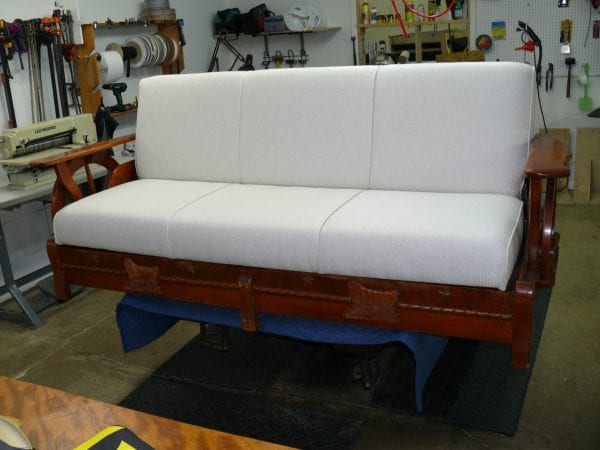
The modern. MOO BENCH
- Project: Reupholstery and Repair
- Category: Furniture Upholstery
Our Task
We provided completely new upholstery for this MOO BENCH



The modern. MOO BENCH
We provided completely new upholstery for this MOO BENCH
A bench never gets a day off. It lives in an entryway catching people while they wrestle with boots, waits at the foot of a bed under a mountain of laundry, or seats three kids at a kitchen table where one chair would have held one adult. So when a custom upholstery commission for Uhuru Design’s MOO bench landed in our shop, we were glad to see it. Bench work is simple geometry doing a difficult job, and we like that kind of assignment.
Uhuru builds furniture in Brooklyn with a reputation for salvaged timber, clean steel, and lines that do not chase trends. A bench from a studio like that is not disposable seating. When the pad flattens or the cover scuffs through, the structure underneath still has decades left in it, and that is exactly the situation where skilled upholstery earns its keep.
Mass produced benches are usually a particleboard slab, an inch of low grade foam, and a stapled cover, built to survive the warranty period and not much longer. Studio benches are a different animal. The seat platform is solid lumber or quality plywood, the legs are joined rather than bolted through thin metal plates, and the proportions were drawn by someone who cared where your knees end up.
That quality platform matters to us as upholsterers, because a bench pad is only as good as what it is fastened to. A flat, stiff, well fastened deck lets us control the shape of the foam, keep seam lines straight over the full length, and pull the cover to an even tension so the top reads as one calm surface instead of a row of gentle hills.
We came to modern studio work by way of old furniture. Most of our bench time goes to antique restoration, and the standards that discipline teaches, honest materials, hidden work done as carefully as visible work, transfer straight across to a contemporary piece.
One habit from the antique side that owners appreciate: we protect the parts we are not working on. Exposed timber gets padded and wrapped before the piece moves through the shop, steel legs get taped against scratches, and any wobble or loose fastener we find along the way gets corrected while the piece is apart. A bench should leave here better everywhere, not just under the new cover.
The failure math is stacked against a bench. A chair gets one sitter in one spot. A bench gets sitters at every point along its length, plus people who perch on the front edge, kneel on it to reach a window, or stand on it to change a bulb. Foam compresses hardest where use concentrates, so the middle goes soft while the ends stay firm, and the seat starts telegraphing its age as a visible sag.
Covers absorb the same concentrated abuse. Entry benches collect grit, belt buckles, and wet coats. Dining benches collect everything a table can spill. Add sunlight from a nearby window and you get one bleached, brittle stripe along an otherwise healthy cover. And because a bench top is one long unbroken panel, damage anywhere is damage everywhere; there is no hiding a worn patch the way a chair cushion hides its flip side.
A few signs it is time to bring a bench in:
Every commission starts with inspection. We check the deck for cracks and loose fastenings, confirm the frame is square, and only then talk padding. On an antique piece we would pause here and weigh preservation against renewal, saving original hair stuffing and hand stitched edge rolls whenever they are sound. On a modern bench the judgment usually tips the other way: the foam is a consumable, the frame is the treasure, and fresh materials are the respectful choice.
The core gets specified, never guessed. We cut high resilience foam to the deck’s exact footprint, radius the top edges so the cover will not shear against a sharp corner, and laminate layers when the design calls for a firmer base under a softer crown. A polyester batting wrap goes over the foam to round the profile and keep the cover from rubbing directly on the core, which is the quiet detail that makes upholstery last.
Templating deserves its own mention, because studio benches are rarely simple rectangles. Decks taper, corners get clipped around legs, and steel frames leave notches the pad must wrap around. We template irregular decks with kraft paper, transfer the outline to the foam with the seam allowances already reasoned out, and test fit before anything is glued. Attachment gets engineered too: screws from beneath into a captive top, hook and loop for a pad that lifts off for cleaning, or ties where the frame is open. The right answer depends on how the bench lives, and it is a decision, not an afterthought.
Then comes patterning of the cover itself. Long straight seams are unforgiving; a wander of an eighth of an inch shows from across the room. We measure, chalk, cut, and sew with the seam allowance held consistent over the full run, then fit the cover dry before a single staple goes in. The same discipline shows up whether we are working on the highback wingback chair we rebuilt or a magnificent Victorian piece from the 1800s that needed its entire suspension redone. Scale changes. Standards do not.
Foam has two numbers that matter, and most people only ever hear one. Density describes how much material is actually in the foam and predicts how long it will last. Firmness describes how hard it pushes back the moment you sit. A dense, medium firm foam stays supportive and springs back for years. A cheap, firm foam feels fine in the showroom and collapses within a couple of seasons. We specify density first, firmness second.
Use decides the numbers. Dining benches want firmer, taller support so sitters stay at a comfortable height for the length of a meal. A bedroom or window bench can afford a softer, lounge feel. The wrap is the seasoning on top: Dacron gives a clean, slightly crowned profile, while a fiber and down wrap softens the first moment of sitting. We talk all of it through in plain language, and if you want the wider map of options, our guide to the different types of furniture restoration services sorts out which approach fits which piece.
Bench covers need muscle. We steer entry and dining benches toward tightly woven performance fabrics or protected leathers, materials with double rub ratings far past residential minimums and stain resistance that actually survives real cleaning. Our fabrics and leather upholstery library holds hundreds of options, and we will pull a short stack that fits both the design of the piece and the traffic it faces every day.
Environment matters as much as material. The conservation scientists at the Smithsonian Museum Conservation Institute study how light, humidity, and handling age objects, and their findings back up the shop wisdom: keep upholstered pieces out of direct sun, hold indoor humidity steady through the seasons, and vacuum textiles gently and often. Water is the one enemy that demands speed. If a bench ever takes real water from a burst pipe or a wet basement, move fast and call for help; we covered what is realistically salvageable in our post on whether flood damaged furniture can be restored.
Usually, yes. We fabricate an upholstered top that fastens cleanly to the existing structure, or a boxed cushion held in place by discreet ties or hook and loop tape. The goal is an addition that looks like it was always part of the piece, not a pillow parked on top of it.
Noticeably firmer. A dining sitter needs consistent support at table height for an hour at a time, and soft foam lets you sink below the comfortable range. We save the plush builds for bedroom and window seating, where sinking in is the whole point.
That is our default. We photograph and measure the original seams, welts, and corner treatments before teardown and reproduce them unless you ask for a change. On a designer piece, the stitching is part of the signature, and we treat it that way.
If your bench, studio built or family hand me down, is sitting thin, send us a few photos and measurements through our quote request page, or call 717-383-6917 and describe what you have. Every piece is quoted individually after inspection, and we will tell you plainly what it needs before anyone lifts a tack puller.
 Get a Free Quote!