Project Details
Club chair
- Project: Reupholstery and Repair
- Category: Furniture Upholstery
Our Task
Reupholstery with Crypton fabric
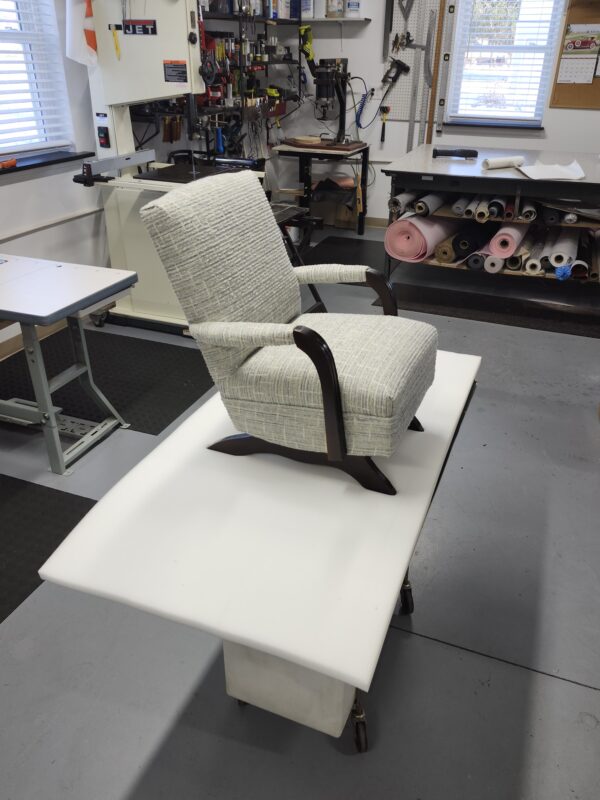
Somewhere around the middle of the last century, chairs went on a diet. The heavy skirts and deep buttoning of earlier generations gave way to clean frames, floating seats, and backs that curve around the sitter in one continuous, sinuous sweep. That wraparound curve is what gives the so called boa back its nickname. The back rail coils around you the way its namesake would, though considerably more politely.
Owners of these chairs tend to be devoted to them, and for good reason. Good mid century seating has a lightness that nothing before or since quite matches, and original examples get harder to find every year. So when a set of curved back chairs shows up at our shop with tired seats and crumbling padding, we treat the job as what it is, the preservation of a design that people will still be arguing over and admiring in another seventy years.
To restore a mid century chair well, you first have to respect how differently it was made from its Victorian grandparents. The older tradition built comfort out of mass. Coil springs hand tied eight ways, dense horsehair, layer upon layer of cotton batting, all of it lashed to a heavy hardwood frame. The mid century makers threw nearly all of that out. Comfort now came from engineering, not bulk. Thin frames of teak, walnut, or beech were shaped to support the body, and the padding became a slim, precise layer instead of a stuffed mattress.
That shift changed the support systems too. Instead of coil springs, many of these chairs ride on rubberized webbing or on sinuous wire springs, the S shaped steel strips that zigzag across the seat frame. Both were brilliant, inexpensive solutions in their day, and both have a service life that has now well and truly expired. Understanding which system a chair uses, and what the designer intended it to feel like, is half the battle of an honest restoration.
Style identification matters, because the market is flooded with later reproductions and the differences hide in the details. Turn the chair over and look. Original mid century frames usually show solid wood rails, clean machine cut joinery, and often a maker’s stamp, a paper label, or a country of origin mark. Tapered, splayed legs that thread or screw into brackets suggest genuine period manufacture. Sheet metal fasteners, particle board rails, or staples the size of croquet hoops usually mean a later copy.
The back tells its own story. A true boa style back is typically a laminated or steam bent curve, shaped as one flowing element rather than an upholstered box. Run your hand along the inside edge. Period bentwood and laminate work feels continuous and light. If you are curious about the lineage of these forms and the designers who developed them, the Furniture History Society publishes serious research on exactly this era, and it is a rabbit hole worth falling into. Knowing what you own changes how it should be treated, which is why identification is always our first step when a curved back chair lands on the bench.
Here is the irony of mid century furniture. The frames were often excellent and the soft materials were often experimental, which means the wood outlives the upholstery by decades. Latex and early polyurethane foams were miracles in the 1950s and 1960s, but chemistry catches up with them. Old foam oxidizes, turns amber, and crumbles into powder that sifts out of the cover like brown sugar. If your vintage chair exhales a little dust cloud when you sit down, that is the foam announcing its retirement.
Rubberized webbing fails in its own way. The rubber dries, cracks, and lets go, usually one strap at a time, so the seat develops a lopsided hammock feel. Sinuous springs fare better but lose their clips or fatigue at the bends. Covers from the era, often wool or early synthetics, wear thin at the front edge and fade unevenly. None of this is a tragedy. Every one of these failures has a clean, proven fix, and because the padding was always meant to be a replaceable layer, renewing it does not compromise the chair’s integrity the way gutting a hand stuffed Victorian would. We covered where that line falls between different levels of intervention in our guide to the different types of furniture restoration services.
Vintage work sits under the same roof as our antique restoration service, and it follows the same discipline even though the materials are younger. When one of these chairs comes into the shop, we start by mapping it. Photographs, measurements, notes on how the original cover was cut and where the seams landed, because with mid century work the tailoring is the design. Then the old cover comes off carefully enough to serve as a pattern, the dead foam gets cleared away, and we evaluate the frame. Loose joints are cleaned and reglued. Bent laminations are checked for delamination, which can usually be repaired with clamps and patience if caught early.
Support comes next. We replace tired rubber webbing with new elasticized webbing of the correct tension, or renew sinuous springs and their clips, aiming for the firm but forgiving feel these chairs had when new. The padding gets rebuilt with modern high resilience foam, wrapped as the era intended, in slim, taut profiles rather than plump ones. This is where judgment matters. On a chair like this we preserve every original element that still does its job, especially the frame finish and any maker’s labels, and we replace only what has genuinely failed. Even moisture damaged pieces are usually salvageable, something we wrote about in answering the question of whether flood damaged furniture can be restored.
The final upholstery is cut from the saved pattern, sewn, and fitted drum tight. Cushion work gets the same attention, since a boxy, overstuffed cushion can ruin a lean frame faster than any stain. Our cushion services exist for exactly this reason, matching density, crown, and seam placement to the design instead of to whatever foam block is closest to hand.
Mid century designers loved textured, honest cloth. Nubby wools, boucles, flat weaves in saturated color, leather with visible character. Those remain the most flattering choices for these frames, and modern versions are tougher and easier to clean than anything available in 1958. Performance boucles and wool blends now shrug off stains that would have doomed the originals.
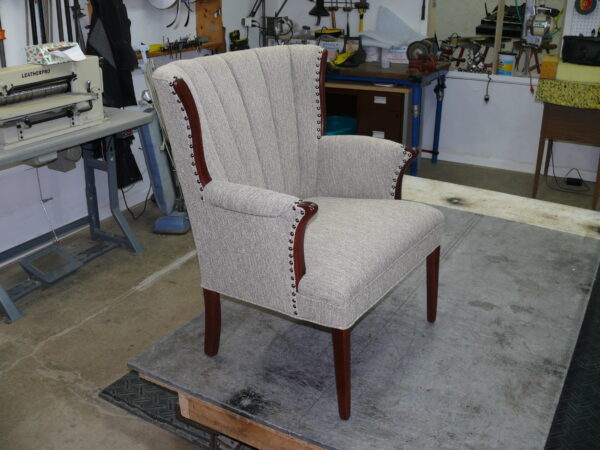
What we gently steer owners away from is fabric that argues with the design. Large florals, heavy damasks, and deep pile velvets belong to a different tradition. We keep a wall of samples in the shop for exactly these conversations, and the contrast is instructive. The same week we might be tailoring a flat weave onto a lean Danish frame while across the room the diamond tufted antique wingback we restored was getting buttons and deep pleats, and the channel back chair we rebuilt needed each vertical channel packed by hand. Each style demands its own logic. Mixing them up flatters none of them.
Once restored, these chairs are refreshingly easy to live with. Keep them out of prolonged direct sun, which is hard on both the fabric and the oiled or lacquered wood. Rotate seat cushions if the design allows, so wear spreads evenly. Vacuum the upholstery monthly with a soft brush, and treat spills by blotting immediately rather than rubbing. Wood frames want an occasional wipe with a barely damp cloth and, for oiled finishes, a light reoiling every year or two.
Humidity swings deserve respect too. Bent laminations and glued joints prefer a steady environment, so a spot next to a radiator or a heat vent is the worst seat in the house for the chair itself. Give it decent conditions and a restored mid century chair will honestly outlast most furniture being manufactured today.
Check the underside first. Solid wood rails, clean joinery, maker’s stamps or labels, and legs that attach with threaded hardware all point to period manufacture. Crumbling amber foam inside is, oddly, a good sign, since it dates the padding to the era. If you are unsure, bring the chair by and we will read the evidence with you.
Often, yes. If the cover is sound and you love it, we can sometimes open the chair, replace the failed foam and webbing, and close it back up with the original fabric preserved. It depends on how brittle the cloth has become, which we can only judge in hand.
Not at all, and we usually encourage it. The frame and the silhouette carry the design. As long as the texture and weight of the new cloth suit the period look, a modern fiber underneath is simply a better tool doing an old job. The designers themselves used the newest textiles they could get.
If you have a curved back beauty losing its stuffing, let us bring it back properly. Request a quote, or call the shop at 717-383-6917 and describe what you have. Every piece is evaluated and quoted individually after inspection, and vintage chairs like these are always welcome on our benches.