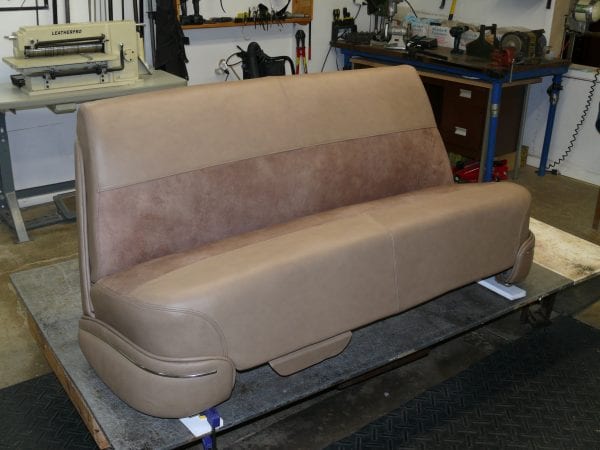



Project Details
Audi A6 2006 Front Leather Seats upholstery needed.
- Project: Classic Auto
- Category: Auto Upholstery
Our Task
After applying Alex’s upholstery skill Audi Saets seats were brought to life.



Audi A6 2006 Front Leather Seats upholstery needed.
After applying Alex’s upholstery skill Audi Saets seats were brought to life.
Nobody writes love songs about a 2006 Audi A6, but spend an hour in one and you understand why owners keep them long past the age when most sedans get traded away. The C6 generation cabin was assembled with a seriousness that puts plenty of newer cars to shame, and the leather seats carry a big share of that spell.
Those same seats are usually the first thing to show the miles. Leather that gets slid across a dozen times a day wears exactly where you would predict, and by the time one of these sedans reaches our shop, the driver bolster has typically paid the toll for every commute it ever hosted.
Audi trimmed these cars in corrected grain leather over firm, multi density foam, shaped by seat engineers who clearly commuted long distances themselves. The seats hold you without squeezing, the stitching is dense and even, and the hides were finished to shrug off years of daily use before showing strain. Even the leather smell was engineered on purpose.
There is also a surprising amount of technology sleeping under that hide. Heating elements sit just beneath the surface of the cushion and backrest. The outboard bolsters of the front seats house side airbags that deploy straight through the cover along an engineered seam. The passenger cushion hides an occupancy sensor that tells the airbag system who is sitting there. A seat from this era is as much an electronic assembly as it is furniture, and it has to be treated that way from the first bolt to the last hog ring.
That combination, real hides plus buried electronics, is exactly why these seats are worth restoring rather than replacing. A used seat from a salvage yard arrives with its own fifteen years of wear and its own tired sensors. Rebuilding the seat you already own keeps the parts that work and renews the parts that touch you.
The driver side outer bolster fails first, nearly every time. It takes a sliding load with every entry and exit, so the protective finish wears through, then the dye, then the hide itself. Once cracks open, grit works in like sandpaper and the damage accelerates from slow to sudden.
Dryness does the quieter damage. Cabin heat, seat heaters, and sunlight pull the oils out of leather season after season. Perforated centers, common on these cars, can tear along the perforation rows once the material stiffens. Underneath it all, the bolster foam crushes and loses its edge, which lets the cover flex more than it should and speeds the wear even further.
Back seats age differently. They see less friction but just as much sun and dryness, so they tend to fade and stiffen rather than crack. That difference matters when we plan a repair, because a color match against a faded rear bench is a match against a moving target.
Here is the plain checklist we give A6 owners who call and ask if it is time:
Any one of those means it is time to act, because leather damage never negotiates. It only spreads.
Working on seats from this era means respecting the systems inside them. Before a seat comes out of the car, the battery is disconnected and the airbag circuits are given time to power down. Every connector is photographed and handled gently, because the occupancy sensor and its wiring do not forgive rough treatment, and a fault there means warning lights that will not go away on their own.
When we build a new cover for a seat with a side airbag, the seam over the deployment path is sewn to release exactly the way the engineers intended. That is not a place for creative stitching, doubled material, or heavier thread than the design calls for. The heating mats are inspected during teardown, transferred or replaced as needed, and the new cover has to lie against them smoothly so warmth spreads evenly and nothing chafes a wire.
The rest is the craft we bring to every era of vehicle: patterns pulled precisely from the old covers, bolster foam rebuilt to its original edge, steam, patience, and fasteners in the right places. The discipline is the same one we used on the 1969 AMC Javelin we reupholstered. Only the details and the wiring change.
Foam work deserves its own mention. A bolster does not just wear on the surface, it collapses at the corner where you pivot on the way out of the car, and no cover in the world can hide that geometry. We rebuild the shape with layered foam, bonded and shaved until the edge reads factory sharp, before any hide gets cut. Foam first, leather second is the order of operations that separates seats that look upholstered from seats that look restored.
Color match makes or breaks a partial repair. We match against a protected area of the original hide, somewhere the sun never reached, rather than against the faded surface everyone sees. Automotive leather suppliers stock hides embossed with grains that sit convincingly next to the factory material, and finish sheen matters as much as color, so we check both in daylight and under shop light before a single panel is cut.
While the seats are apart, it pays to look at the rest of the touch points. Center armrests, door pulls, and headrests wear on the same schedule as the cushions, and refreshing them from the same batch of hide keeps the cabin honest. Nothing exposes a repair like a crisp new bolster sitting beside a shiny, worn armrest, so we plan the match across every surface your hands and shoulders actually meet.
Some owners take the opportunity to go further and replace everything in a better hide than the factory used, which turns a repair into an upgrade. Others ask about high grade synthetics, and honestly, they have earned the conversation. Our piece on faux leather as an upholstery material covers where the modern synthetics shine and where they fall short. On a high wear bolster, a quality synthetic panel can outlast the original finish while staying visually invisible.
Vinyl impersonating leather is not a new act, either. Detroit had it perfected decades before this Audi was born, and the 1969 Pontiac dressed in Madrid Morrokide that came through our shop shows just how convincing the old masters were. The materials keep improving. The idea never changed.
Conservators at the Smithsonian Museum Conservation Institute point out that leather survives best in stable, moderate humidity, away from strong light and heat. A daily driver cannot live in a museum case, but the principles translate directly: park in shade when you can, use a windshield screen in summer, and let the climate control do its job instead of roasting the cabin.
Grit is the other villain. Dust and fine dirt grind the finish off leather every time you slide across the seat, and the cure is nothing but habit. Our short guide on keeping dirt and dust off your seats applies to leather every bit as much as vinyl. Clean with a damp microfiber and a mild leather cleaner, condition two or three times a year, and skip anything that promises a wet shine.
One more habit worth forming in winter: let the seat heater warm you, not roast you. Long sessions at the highest setting slowly dry the hide from below, while the lowest setting does the same job far more gently. Your leather will thank you in about five years, which is how leather says thanks.
We preach the same sun doctrine in our motorcycle upholstery work, where the seat has no roof at all and UV is the whole battle. Shade is free, and it is the best conditioner ever invented.
Not when the work is done correctly. The deployment seam is sewn to factory intent with the proper thread and placement, and we never block or reroute the bag’s path. This is the single biggest reason late model seat work belongs in a professional shop rather than a weekend project.
Often, yes. If the rest of the seat is healthy, we rebuild the bolster foam and replace that one panel with matched leather. When fading is widespread, a full cover gives the better result, and we will tell you plainly which side of that line your seat sits on after we inspect it.
Yes. The elements are checked during teardown, handled carefully during the build, and tested before the seat goes back into the car. If a heater was already dead, this is the ideal moment to fix it while everything is open.
If your A6, or any late model interior, is showing its miles, request a quote or call 717-383-6917. Bring us the wear, and our auto upholstery service will hand back seats that feel the way the engineers meant them to.
 Get a Free Quote!