


Project Details
- Motorhome Ford 2013
- Category: Auto Upholstery
Our Task
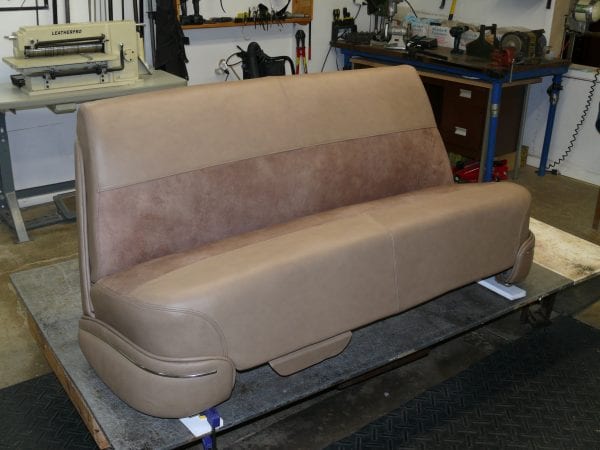
Reupholstery Sofa and sleep sofa



Reupholstery Sofa and sleep sofa
A motorhome sofa lives a double life. At camp it is the family couch, the card table bench, and the guest bed. On the highway it is a piece of furniture doing sixty five miles an hour on a Ford chassis, flexing with every expansion joint and soaking up sun through windows the size of storefronts. House furniture never has to pass a road test. This furniture does.
So when the sofa and seats from a Ford based coach arrive in our shop, we treat the project as the hybrid it is: part living room, part vehicle interior, with the rules of both worlds applying at once.
RV builders work under two masters, weight and speed of assembly, and the furniture shows it. Frames are light plywood stapled together fast, foam is chosen thin to save pounds, and covers are stapled rather than tacked. Jackknife sofas fold flat into beds on steel mechanisms, dinette cushions moonlight as mattress sections, and the driver and passenger chairs swivel to face the living space when the parking brake goes on.
There are vehicle rules layered on top. Upholstery in a motor vehicle is expected to meet flammability standards that living room fabric never has to think about, and any sofa carrying seat belt anchors is part of the safety system, not just the decor. That is why coach furniture belongs in a shop that understands vehicles, and why we fold this work into our auto upholstery service rather than treating it like household work with wheels.
None of this means the factory furniture was bad. It means it was built to a shipping weight. A rebuild is the one chance in the vehicle’s life to keep the light frame philosophy while upgrading everything that touches the people.
The sofa and chairs are usually just the headliners of a bigger cast, too. Dinette cushions, bunk mattresses, window valances, and the padded panels around the cab all belong to the same interior, and they all age together. We are glad to take the project one piece at a time, but it helps to plan the order early, so the materials carry through the whole coach instead of running out halfway down the hallway.
Sunlight is the big one. A motorhome is a rolling greenhouse, and the sofa sits in the bright spot all day, every day, even in storage. UV fades fabric, embrittles vinyl, and cooks the top surface of foam until it stops springing back.
Then there is the double shift. A cushion that works as a couch by day and a bed by night compresses twice as many hours as anything in your house, and thin factory foam fatigues early under that schedule. Add the vibration of travel, which slowly works staples loose and lets seams creep, and the humidity swings of a vehicle that sits closed up for months, which invite mildew into any cushion that went into storage damp.
Foam also loses its loft fastest at the front edge of a seat cushion, where knees and heels load it every single day. That is why so many coach sofas look perfectly fine in photos and sit terribly in person.
The result is furniture that can look eight years old after three. Owners often blame themselves. It is not you. It is physics working overtime in a small glass box.
Owners often ask what we need to know, so here is the short walkthrough we suggest doing with a notebook in hand:
Ten minutes of that tells us most of what we need for a first conversation, and photographs of what you find tell us the rest.
We start in the coach itself, because measurements taken in place catch the things that matter: how the jackknife mechanism sweeps, where the seat belts anchor, which panels have to come out first. Then the pieces come to the shop, and each one is stripped to its frame.
Frames get reinforced where the factory economized, corner blocks added, staples replaced with screws at load points. Mechanisms are cleaned and lubricated so a sofa that fought you for years folds with two fingers. Foam is upgraded to high resilience grades, chosen firmer for the seating layer and softer for sleeping comfort where a cushion serves both duties. Then patterns, cutting, and sewing, the same craft we apply to everything from the 1968 Ford Torino GT seats we restored to delivery fleets. If you are curious where all this happens, you are welcome to tour our shop and watch a cushion come together from bare frame to final steam.
Preservation calls come up here too. Woodwork, trim rails, and hardware original to the coach usually clean up beautifully and keep the character of the era, so we save them wherever they are sound. The goal is a coach that feels like itself, only healthier.
Logistics turn out easier than most owners expect. The furniture almost always comes out of the coach and travels to us on its own, so the motorhome itself only needs to visit for measuring and final fitting. Plenty of owners drop pieces off on the way home from the season’s last trip and collect them before the first one in spring, which quietly turns storage months into shop months.
Fabric choice in a motorhome is a three way negotiation between sunlight, cleanability, and weight. High performance woven fabrics with UV stable fibers handle the greenhouse problem. Modern coated fabrics handle the spilled coffee problem. And every yard we add has to justify itself on the scale, because a motorhome diet always matters.
Synthetic leathers deserve special mention, because they have become the sweet spot for a lot of coaches: the wipe clean practicality of vinyl with a hand and look that reads far richer. We covered the material honestly, strengths and limits both, in our piece on faux leather as an upholstery material. In a vehicle that hosts sunscreen, snacks, and the occasional wet dog, it is a very rational luxury.
The broader aftermarket keeps making this easier. The specialty equipment world that gathers around SEMA has pushed better foams, better coated fabrics, and better hardware into the market every year, and coach owners get to harvest all of it. A rebuild today can genuinely outperform the same furniture as it left the factory, the way the classic commercial truck interior we finished for a showroom outshines its own original build sheet.
Color deserves one practical warning from years of coach work: very dark surfaces near big windows get hot enough to be uncomfortable by mid afternoon, and very light ones show every footprint of the trail. The happy middle, midtone shades with a little pattern to them, hides the life a camper actually lives.
Storage is where coach interiors are won or lost. Park with the shades drawn or windshield covered, crack a roof vent if the coach allows it, and put a moisture absorber in the cabin for the winter. Cushions stored slightly propped, so air reaches both faces, come out of hibernation smelling like nothing at all, which is exactly the goal.
During the season, the routine is simple: keep grit off the seating so it cannot grind at the fibers, wipe coated surfaces before spills cure in the heat, and vacuum the crevices where sand collects. Our short guide on protecting seats from dirt and dust was written with vehicles exactly like this in mind. Five minutes at the end of a trip beats an afternoon of scrubbing in spring.
Yes, and it should fold better than before. We service the mechanism while the frame is bare and build the new cushions to thicknesses that clear the fold. A rebuilt sofa that no longer makes into a bed is a rebuild done wrong.
Absolutely, and we encourage it. The cockpit chairs are usually the most worn pieces in the coach, and covering everything in one coordinated material set is what makes the interior feel finished rather than patched.
It changes the details. We lean harder on mildew resistant backings, breathable constructions, and foams that tolerate long compression free storage. Tell us how the coach lives and we will build for that life.
If your rolling living room has stopped feeling like a treat, send photos through our free online estimate or call 717-383-6917. We will help you sort what needs rebuilding from what needs nothing at all, and the trip after that will feel like a new coach.
 Get a Free Quote!